

State DOTs: We Back National Transport Goals — If We Get to Write Them


Congressional efforts to set national goals for the American transportation system are stalled for now, but the U.S. DOT said today that it is preparing for an eventual transition to a world where performance targets are the norm for transit, roads, bridges, and ports.
 (Photo: UVA)
“National goals should be set by U.S. DOT in collaboration with states and stakeholders,” Federal Highway Administration executive director Jeffrey Paniatti said yesterday during a session of the Transportation Research Board (TRB) conference.
But how will Washington measure progress on transportation metrics such as safety, pollution reduction, and efficiency in states that are, as Paniatti put it gently, “starting from different places”?
Pete Rahn, the chief of Missouri’s state DOT and past president of the American Association of State Highway and Transportation Officials (AASHTO), had a simple answer: States should be in charge of the process.
“We believe there should be a state-driven performance management approach,” Rahn told TRB attendees, in which “states establish targets which they can deliver given their unique circumstances.”
At AASHTO, he added, “we don’t envision a process in which the Secretary of the U.S. DOT will dole out a share of a target to each state … U.S. DOT would establish targets and we’d certainly hope that the total cumulative balance of state targets would equal the national [goal].”
If state-written targets don’t meet national performance standards, “that means the national target is not realistic,” according to Rahn.
AASHTO’s lack of interest in meeting transportation goals that are not written within their ranks could create a major headache for the Obama administration, should it pursue broader infrastructure reform that would hold state DOTs accountable for their spending.
Letting states craft performance measures internally would risk rigging the system to ensure that DOTs always meet their targets — but if the federal government wanted to effect broader change on a state or regional level, such as lower emissions or fewer pedestrian deaths, where would it get leverage?
Both Paniatti and Rahn ruled out any attempt to threaten a loss of federal transportation funding if goals were not met, a tactic successfully used in the 1980s to set the national speed limit at 55 miles per hour.
In fact, Rahn fondly recalled his past work at a state DOT that successfully gamed the speed-limit system. “We chose to put our speed sensors in really sharp corners,” he told the TRB audience, drawing sporadic chuckles. “That’s why [the push for national transportation targets] has to be a project we work on together.”
While state DOTs work to shape the Obama administration’s progress on national transportation goals, it’s unclear whether any advocacy or lobbying group exists to counter their influence.
Jay-Etta Hecker, an infrastructure specialist at the Bipartisan Policy Center’s transportation project, countered the suggestion from one state DOT official that performance metrics ought to remain secret — the data “has got to be available to the public,” she said. But she also emphasized that “the states should be the ones to interpret [national performance goals] in a locally relevant way.”
Paniatti noted in his TRB remarks that the U.S. DOT is currently working on two major research projects intended to guide the writing and implementation of nationwide transportation targets.


Support Streetsblog
More from Streetsblog USA
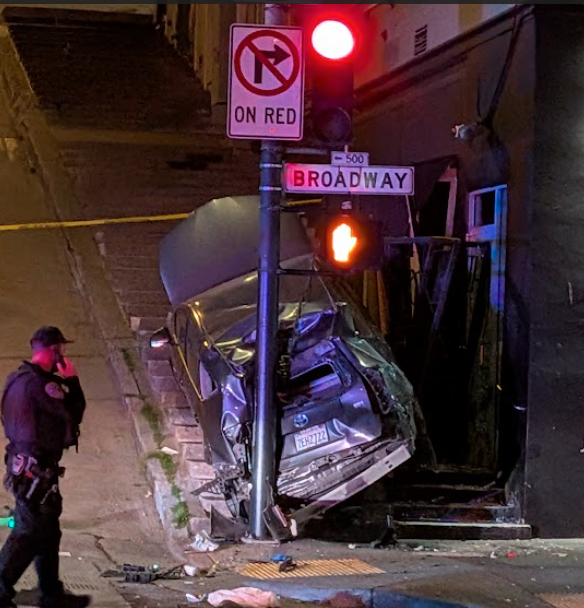
Motorist Careens onto North Beach Sidewalk, Killing Pedestrian
Driver kills pedestrian at another location where a safety project festered
The post Motorist Careens onto North Beach Sidewalk, Killing Pedestrian appeared first on Streetsblog San Francisco.






Comments Are Temporarily Disabled
Streetsblog is in the process of migrating our commenting system. During this transition, commenting is temporarily unavailable.
Once the migration is complete, you will be able to log back in and will have full access to your comment history. We appreciate your patience and look forward to having you back in the conversation soon.