Form-Based Codes Mean More Sustainable Cities
A new study finds that focusing on the “form” of buildings rather than what those buildings are used for can make cities more walkable, livable, and sustainable — and that conventional zoning is making car dependency and sprawl worse.
A research team composed of Arianna Salazar-Miranda and Emily Talen from the University of Chicago and Yale University analyzed planning documents from over 2,000 communities across the country to identify what they call “form-based code language,” and uncover the impact those policies have on how residents move.
“Traditional zoning has made it hard to build mixed-use, compact, and connected neighborhoods — the kinds of places where walking becomes a feasible option,” says Salazar-Miranda.
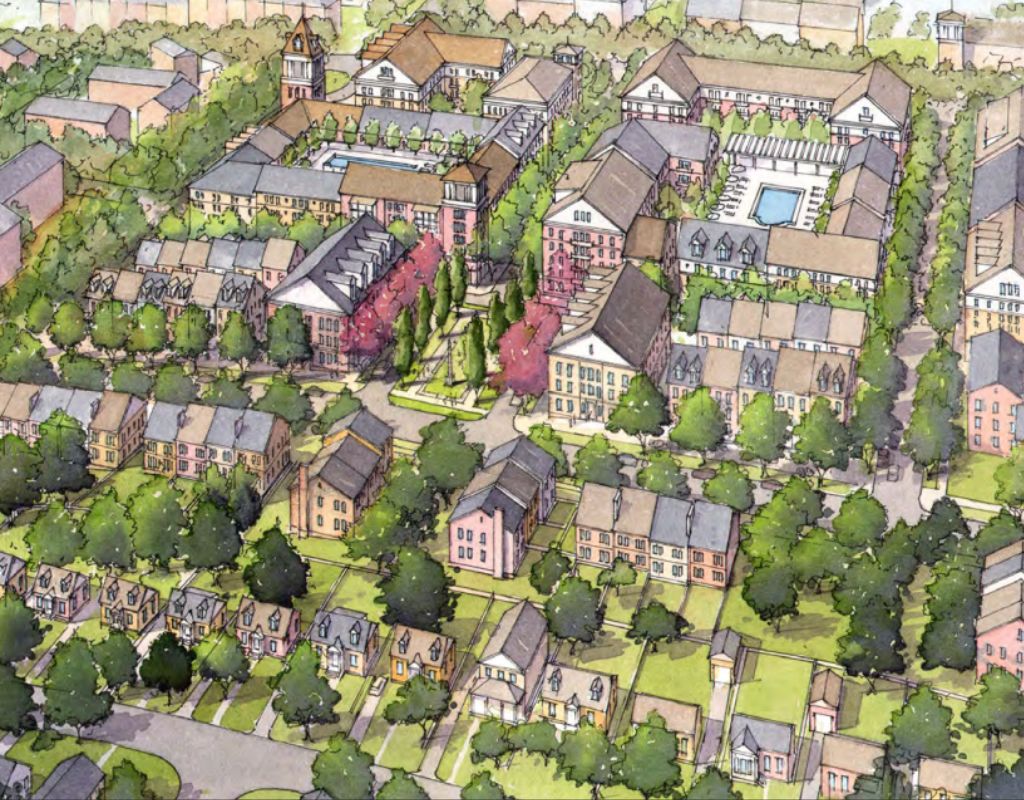
Popularized at the end of the 20th century, a form-based code is a planning standard that focuses on the physical “form” of buildings instead of whether they’re residential, commercial, industrial, or agricultural, removing barriers to building neighborhoods where homes are located near jobs and other destinations. According to Planetizen, its guiding principle maintains that the “form of buildings is more important than the use in determining community character,” and that communities should mandate what they want buildings to look like — and the design of the streets they are located on — rather than mandating, say, where restaurants, apartment buildings, and office spaces can be.

Photo: G. Edward Johnson via Wikimedia Commons
Salazar-Miranda says that form-based codes are “changing urban form in measurable ways and supporting more sustainable behaviors” by using limited urban land more efficiently. She highlights the key urban design results of “smaller setbacks, denser development, more housing types, and less parking.”
As jurisdictions around the country explore ways to maximize their scarce land, form-based codes fit in well with policies permitting the construction of “accessory dwelling units” like backyard cottages, and the subdivision of current plots to build multiple buildings on the same parcel.
At a more human level, the team found that form-based codes are also connected to “higher walkability scores, shorter commute distances, [and more] multi-family housing” Additionally, these benefits “[do] not vary significantly across demographic characteristics, such as income, race and education,” signaling that the ditching Euclidian zoning could offer a more holistic approach to producing walkable, mixed-use, and dense neighborhoods with results for all types of communities.
And it’s already happening — even if not at the same rate everywhere. While the researchers found that while the principles behind form-based codes are prevalent across the country, there are differences between how widely regions implement them. Notably, communities in the car-dependent South lead in adoption, an indicator that form-based codes can work in even the most auto-centric regions. Just recently, Orange County, Florida adopted a form-based code to rein in Orlando’s sprawl.
That’s not to say that form-based codes can solve all of the problems created by traditional zoning. Salazar-Miranda acknowledges that although these codes “give cities a powerful lever to shape the kind of environments that support walking and reduce car dependence, zoning alone is probably not enough.” That’s why she says form-based codes should be “paired with investments in sidewalks, safe crossings, and other pedestrian infrastructure to ensure that walkable form actually translates into walkable function.”

Read More:
Streetsblog has migrated to a new comment system. New commenters can register directly in the comments section of any article. Returning commenters: your previous comments and display name have been preserved, but you'll need to reclaim your account by clicking "Forgot your password?" on the sign-in form, entering your email, and following the verification link to set a new password — this is required because passwords could not be carried over during the migration. For questions, contact tips@streetsblog.org.
More from Streetsblog USA
Motorist Careens onto North Beach Sidewalk, Killing Pedestrian
Driver kills pedestrian at another location where a safety project festered
The post Motorist Careens onto North Beach Sidewalk, Killing Pedestrian appeared first on Streetsblog San Francisco.