Opinion: It’s Time to Update the 15-Minute City
Since the early 20th century, cities have been optimized for the benefit of industry, commerce and the automobile. As a result, cities were organized into distinct zones of like activities; factories in one zone, shopping in another, nice single-family homes on one side of the tracks and housing for those who didn’t fit that family model on the other side. These zones were efficiently connected with roads and highways to make it easy for people to get from a living zone to a specific type of work zone and help the economy hum.
It was a model that supported society’s enthusiastic devotion to engineered efficiency.
So it is not surprising that when city planners started thinking about a more human-scaled of urban living — the 15-minute city — they continued to use the measurements and language of efficiency as their guide.
Defined as the ability of citizens to get to everything they need within a 15-minute walk, bike ride, or public transit from their home, the term ’15-minute city’ itself implies efficiency. This efficiency narrative resulted in success being measured in terms of minimum time, maximum convenience and short proximity. Human scale was translated into simply meaning smaller scale — a sort of “Honey, I Shrunk the City” planning exercise.
While I am all for the idea of changing our urban scale, I believe the 15-minute city concept can only be feasible — and add real value — when we stop looking at it through the lens of efficiency. We need to consider using the smaller city scale to recapture the thing we have sacrificed the most over the last 50 years of engineered efficiency: meaningful social connection.
In other words, we must replace the goal of “proximity to things” with the goal of the “participation of people.”
An example of the feasibility challenges faced by the “15-minute city” framework is that it’s hard to shrink a city that is segregated into zones. Those darn activities that were supposed to be kept apart tend to bump into each other in a smaller-scale city.

Planners quickly become faced with questions such as, “Can an office building sit beside a nice single-family home?” or “Can affordable housing and a bar that offers live music be located right across the street or even on the next block?” The answer is usually “no” — at least not without massive and very slow-moving zoning changes.
It is also challenging to create retail and services environments that must be commercially viable serving a customer base that lives within 15 minutes. First, the community must become well established, and its ongoing needs well understood. That, too, takes time to develop in an organic fashion.
Most importantly, the 15-minute concept does not take into consideration society’s recent devotion to efficiency in the form of digital technology and the internet. We now get over 50 percent of our needs met via on-line shopping and Amazon, and that number is only going to continue to rise. The new proximity measurement that really matters is the distance between our cellphones and our couches — and those same couches are also where approximately one-third of society’s workforce will be permanently working a portion of each week, according to recent predictions.
Before we proceed with further efficiency objectives, perhaps we should ask: are we a happy society with all this efficiency? Research indicates we are not. Isolation and loneliness are at epidemic proportions. When it comes to our quest for efficiency, we have literally reached the point of diminishing returns.
In 2021, Canadian architect Ashleigh Crofts and I considered these issues as part of a global 15-minute city design competition. Our idea wasn’t so much a laid-out city design as it was an articulation of the idea that a smaller-scale city should allow urban planners to let go of the efficiency ideal and think about daily excursions through a community as a social activity. A straight and sterile five-minute walk from A to B could become a winding eight-minute journey sprinkled with moments of public engagement and joy in which people interact with acquaintances along their excursion or take in the sights of total strangers laugh and play.
The difference in time between five and eight minutes is negligible, but the social and mental health impact of these daily joyful moments is huge.
Despite not really submitting a structured city “design,” our proposal placed third in the world — a strong validation for the idea of an updated 15-minute city approach that included intentional ways to allow a city’s diversity to touch each other in a social fashion.
This type of urban design requires city builders to think less about boundaries, borders and mini-downtowns, and start creating urban edges where social activities and people overlap in playful environments. Edges within nature, such as where a forest meets a meadow, generate the most activity within an ecosystem and give it strength and resilience. We could benefit greatly by learning from nature’s example. We should think of cities as the habitat of the human spirit.

A very simple example of an urban edge is the traditional North American front porch. It is not a completely private space, nor is it fully the public realm. It is where the private life overlaps with the public environment of sidewalks and neighbourhoods. It’s a casual and comfortable space designed to give acquaintances and strangers the opportunity to interact.
The 15-minute city scale holds great potential, but we must release ourselves from past priorities and focus on what society needs today – a social contact. We might also be doing ourselves a favor by giving the idea a new name: The Social City.

Read More:
Streetsblog has migrated to a new comment system. New commenters can register directly in the comments section of any article. Returning commenters: your previous comments and display name have been preserved, but you'll need to reclaim your account by clicking "Forgot your password?" on the sign-in form, entering your email, and following the verification link to set a new password — this is required because passwords could not be carried over during the migration. For questions, contact tips@streetsblog.org.
More from Streetsblog USA
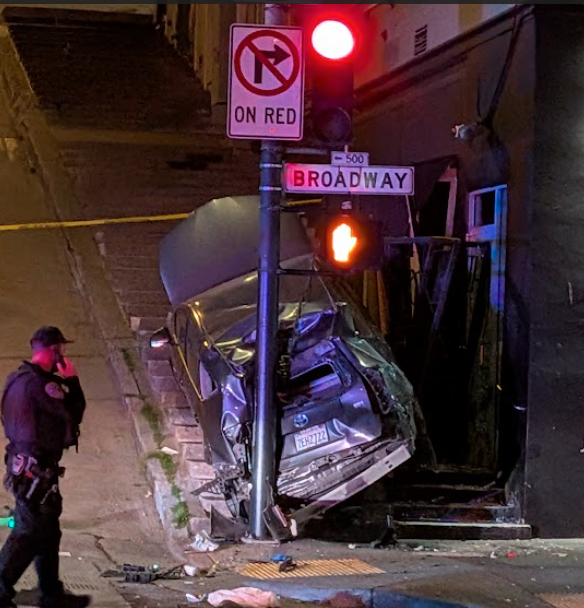
Motorist Careens onto North Beach Sidewalk, Killing Pedestrian
Driver kills pedestrian at another location where a safety project festered
The post Motorist Careens onto North Beach Sidewalk, Killing Pedestrian appeared first on Streetsblog San Francisco.