This is What Victory Looks like, Freeway Fighters

Editor’s note: A version of this article originally appeared on City Observatory and is republished with permission.
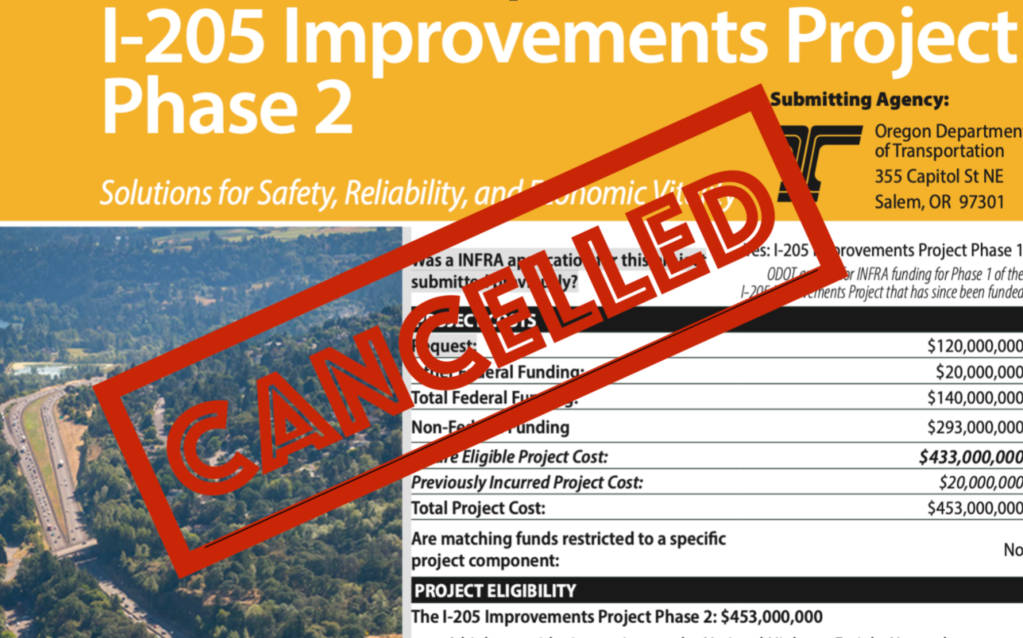
Freeway fights are often long, drawn-out affairs, that involve challenging poorly conceived and wasteful projects at a seemingly unending series of public meetings. In practice, freeway fighters generally lose every single battle—except the last one. The epitaph for one such freeway project, the half billion dollar widening of I-205 south of Portland, the so-called “Phase 2” project, looked like this:

The notice appears in terse language in an appendix to a report listing changes to Oregon’s federally required “State Transportation Investment Plan” or STIP. Until this notice came out, the official status of this project was “indefinitely postponed,” but now it’s clearly dead.
“Revenue uncertainty” is a euphemism for “we have no money to pay for this project, and no prospect of finding any.”
As we reported two months ago, it finally became obvious that the Oregon Department of Transportation simply lacks the funds to pay for a seven-mile long widening of I-205 just outside of Portland.
Opposition to the project was led by No More Freeways, a grassroots Portland group fighting billions of dollars of freeway widening projects being pushed by ODOT. No More Freeways celebrated its Sixth Birthday this past month, and marked the passing of the I-205 project, along with its allies “Youth vs. ODOT”–young climate advocates who’ve relentlessly campaigned against these wasteful projects.

No More Freeways filed detailed objections and critiques of the project technical work in comments on its Environmental Assessment. In addition, NMF’s community members submitted over 300 comments in opposition to the I-205 expansion during the public comment period last spring, including technical comments pointing out the explicit violation of federal environmental protection law.
ODOT’s proposed I-205 expansion was listed as one of the worst transportation projects in the country in USPIRG’s “Highway Boondoggles” report in 2022.
This is how bad projects die: Agencies finally, and reluctantly, concede that they don’t have the money to pay for them, and that they are so bad that no one can be convinced to appropriate (or borrow) the money needed to move them forward.
We can only hope that this first small victory will signal a turning of the tide in the battle against wasteful and counterproductive highway expansion projects. Oregon DOT continues to maintain the “extend and pretend” fiction that its now-$1.9 billion Rose Quarter project is still alive, but it too, will have to yield to the fiscal reality that the highway department is essentially broke and doesn’t have the resources to maintain the roads it currently has, much less build enormously expensive new ones.
Freeways are promoted with extravagant — and usually false — P.R. campaigns. But in the end, their death is often just a bureaucratic footnote.
Streetsblog has migrated to a new comment system. New commenters can register directly in the comments section of any article. Returning commenters: your previous comments and display name have been preserved, but you'll need to reclaim your account by clicking "Forgot your password?" on the sign-in form, entering your email, and following the verification link to set a new password — this is required because passwords could not be carried over during the migration. For questions, contact tips@streetsblog.org.
More from Streetsblog USA
Motorist Careens onto North Beach Sidewalk, Killing Pedestrian
Driver kills pedestrian at another location where a safety project festered
The post Motorist Careens onto North Beach Sidewalk, Killing Pedestrian appeared first on Streetsblog San Francisco.