Two Big Reasons States Keep Expanding Freeways

Editor’s note: A version of this article originally appeared on City Observatory and is republished with permission.
Highway widening advocates offer up a kind of manifest destiny storyline: population and traffic are ever-increasing, and unless we accommodate them we’ll be awash in cars, traffic and gridlock. The rising tide of cars is treated as a irresistible force of nature. But is it? Look more closely and its apparent that rising traffic levels aren’t inevitable, they’re the product of other forces. And far from solving traffic problems, widening roads makes these problems worse.
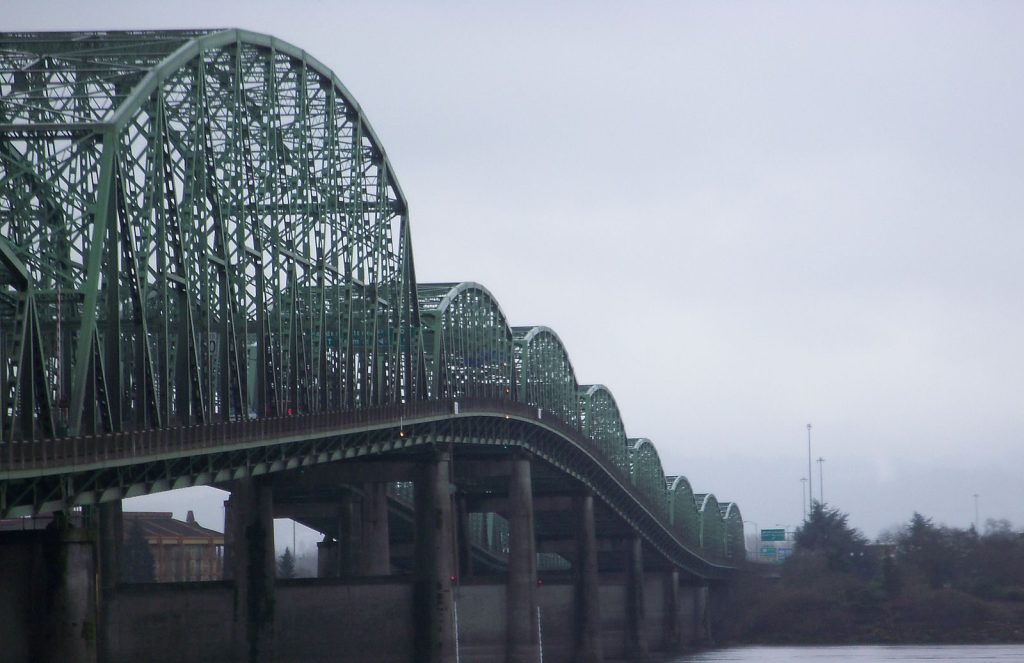
In the case of Portland’s proposed $5 billion five-mile-long freeway widening project — the mis-named Interstate Bridge Replacement project — the real forces behind the project aren’t pre-destined levels of car traffic, but instead, are much more prosaic, and questionable: sprawl and tax evasion.
Sprawl: Cause and consequence of wider roads
While Oregon has some of the tightest land use controls in the nation, Washington State is still far more accommodating to rural and exurban residential development. As many critics of the I-5 bridge project have noted, precious few commuters from Washington State to jobs in Oregon use transit, despite the fact that their are good express bus services from Vancouver to Oregon job centers. (Prior to the pandemic, express buses carried only about 3,000 people per weekday between Oregon and Washington, compared to more than 250,000 vehicles per day crossing the river). A key reason for this auto-dominated travel pattern is that housing growth in Clark County has been driven by exurban sprawl, and workers commuting from these locations travel overwhelmingly by car. Here’s a map prepared by Seattle’s Sightline Institute showing the comparative patterns of population growth in the Oregon and Washington portions of the metropolitan area between 1990 and 2000. While Oregon has had little population growth outside its urban growth boundary–a testament to the policies effectiveness – Washington has experienced a rash of exurban development.

This exurban sprawl is both the source of demands for expanded highway capacity on I-5 and elsewhere, and in turn, widening roads simply encourage more such sprawl—a pattern that is repeated in metropolitan areas across the country. The technical analysis done for the proposed Columbia River Crossing (predecessor of the IBR) estimated that 93 percent of the growth in peak hour trips on I-5 between 2005 and 2030 would result from additional population growth in the suburban fringe of Clark County (i.e. even more purple dots).
Tax evasion fuels traffic growth
While sprawl is one contributor to traffic growth, a second is tax evasion. Here’s the short story: Oregon has no retail sales tax; Washington charges its residents one of the nation’s highest rates (over eight percent). As a result, Washington residents regularly drive across the Columbia River on one of two Interstate Bridges to shop tax-free in Oregon. They spend over $1.5 billion per year in Oregon, and effectively evade more than $120 million in sales taxes by doing so. The average Clark County family of four evades about $1,000 of sales tax each year.
But all these sales tax evasion produces a lot of traffic on the two bridges that cross state lines: we estimate that between 10 and 20 percent of all the trips crossing the I-5 and I-205 Columbia River bridges are Southwest Washington households driving to shopping centers in Oregon to evade Washington sales tax. Conveniently, there are major shopping centers at Jantzen Beach and Hayden Meadows (on I-5) and on Airport Way (I-205), both just across the Columbia River into Oregon. The parking lots of these retail centers are chock-a-block with Washington vehicles.

Far from being inexorable and inevitable forces of nature, the factors driving the growth of traffic between Portland and Vancouver are actually symbolic of dysfunctional and environmentally destructive trends. Rather than accommodating them, and encouraging more sprawl and tax evasion, we should be making choices that are consistent with our stated values.
Streetsblog has migrated to a new comment system. New commenters can register directly in the comments section of any article. Returning commenters: your previous comments and display name have been preserved, but you'll need to reclaim your account by clicking "Forgot your password?" on the sign-in form, entering your email, and following the verification link to set a new password — this is required because passwords could not be carried over during the migration. For questions, contact tips@streetsblog.org.
More from Streetsblog USA
Motorist Careens onto North Beach Sidewalk, Killing Pedestrian
Driver kills pedestrian at another location where a safety project festered
The post Motorist Careens onto North Beach Sidewalk, Killing Pedestrian appeared first on Streetsblog San Francisco.