House Support for Transit is Good, Not Great
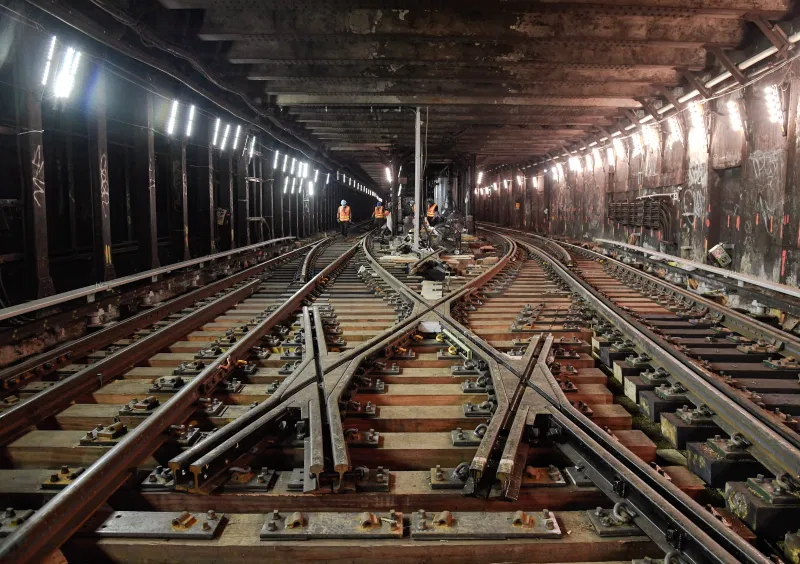
What’s another $9.3 billion among friends?
A House of Representatives committee moved ahead to allocate $30 billion for America’s beleaguered transit systems — including billions for the cash-strapped MTA — but it still won’t be enough to keep millions of riders and hundreds of thousands of workers safe from drastic cuts, transit agencies and advocates said.
First, the good news: Late on Wednesday, the House Transportation and Infrastructure Committee approved a bill that would allocate $30 billion for public transit — a solid $10 billion more than even President “Amtrak Joe” Biden had asked for, Reuters reported. And the Democratic majority rejected a Republican amendment by Rep. Bob Gibbs of Ohio to swipe $10 billion from transit and give it to highways.
Advocates were pleased, but not fully satisfied.
“We thank the Committee for passing this critical funding and encourage them to provide an additional and much-needed $9.3 billion for transit in subsequent legislation,” Transportation For America said in a statement. “Public transit needs $39.3 billion in any economic stimulus or relief legislation to preserve transit service though the rest of the pandemic and into the economic recovery. Without this funding, over 2.8 million essential workers who count on transit won’t be able to get to work. These essential workers power healthcare, grocery, sanitation, and other crucial sectors. In addition, millions of Americans — particularly people of color, who make up 60 percent of transit riders — continue to rely on public transportation as an essential connection to jobs, food, healthcare, education, and other critical services.”
It will certainly come as no shock that transit agencies and advocates want more than the committee allocated. Last week, TransitCenter put out a report that pegged the national transit need at $39.3 billion — to get those agencies through 2023. The report said that Congress’s $30-billion allocation would only save transit through 2022.
And the more, the merrier, the organization said.
“The more emergency funding is secured now, the longer agencies will be able to maintain service before needing another round of relief,” TransitCenter argued. “Because economic activity and transit ridership are not expected to fully rebound immediately following a mass vaccination campaign, the fiscal disruption for transit agencies is projected to last years.”
The MTA is part of a national coalition that includes systems across 22 states (some of them bright red, by the way). That group had sent Congress a letter last week also demanding the $39.3 billion, saying that anything less would fail to address “devastating COVID-related deficits and prevent deep service cuts, thousands of employee layoffs and decimating capital improvement projects as well as the hundreds of thousands of well-paying jobs that would be created along with an infusion of capital spending.”
The group’s letter [PDF] was signed by the top officials at transit systems serving Atlanta, Austin, Baltimore, Boston, Charlotte, Chicago, Cincinnati, Cleveland, Denver, Jacksonville, Los Angeles, Miami, New Orleans, the New York metro area, the San Francisco Bay Area, Philadelphia, San Antonio, Seattle, Tampa and Washington, D.C.
“A strong public transportation network is the shot in the arm this country needs to fully rebound now that the vaccine is here,” the letter concluded. “Federal investment will do more than just keep the trains and buses running; it will help fortify our systems for decades to come. By devoting resources to transit, we can create jobs and strengthen the infrastructure that moves not only people, but our economy.”
Of course, there’s still a fight to make sure that the agencies in question don’t squander whatever money Congress eventually allocates, said Ben Fried of TransitCenter.
“It looks like transit agencies will get significant relief, so the next phase of this fight will be to ensure that they use it to maintain service,” Fried said. “It is not appropriate to spend the COVID relief funding on big-ticket capital projects. We don’t want to save this for a rainy day — this is the money for the rainy day. Riders need agencies to step up and get essential workers to their jobs.”
The full House is expected to take up the matter next week.

Read More:
Streetsblog has migrated to a new comment system. New commenters can register directly in the comments section of any article. Returning commenters: your previous comments and display name have been preserved, but you'll need to reclaim your account by clicking "Forgot your password?" on the sign-in form, entering your email, and following the verification link to set a new password — this is required because passwords could not be carried over during the migration. For questions, contact tips@streetsblog.org.
More from Streetsblog USA
Motorist Careens onto North Beach Sidewalk, Killing Pedestrian
Driver kills pedestrian at another location where a safety project festered
The post Motorist Careens onto North Beach Sidewalk, Killing Pedestrian appeared first on Streetsblog San Francisco.