Houston Rolling Back Parking Requirements
Houston took a step toward becoming an “increasingly urban city” this week when lawmakers put the kibosh on minimum parking requirements in two center-city neighborhoods.
The reform, known locally as “market based parking,” allows developers and business owners to decide how much parking they need at their buildings, rather than conform to an arbitrary number imposed by city law.
The change “will lead to better streetscapes in this transition period of becoming an increasingly urban city, which will help us be greener, healthier and a more walkable Houston,” City Councilmember Karla Cisneros said.
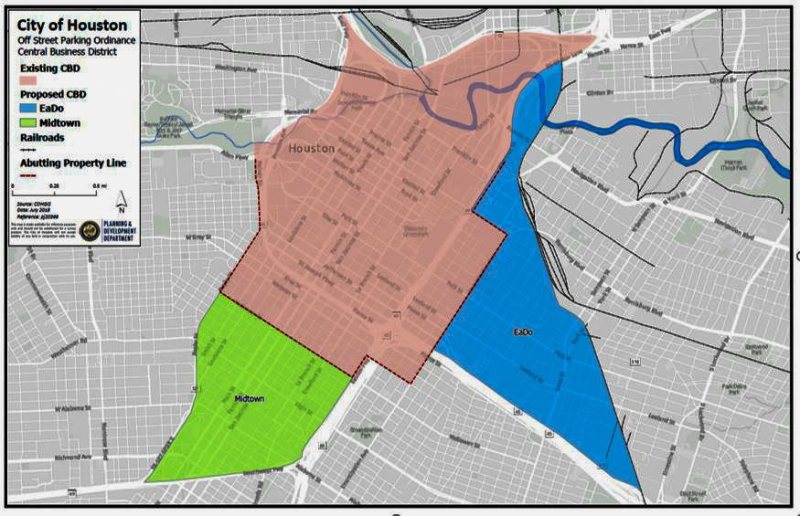
Part of Midtown and Downtown East will be exempt from the city’s minimum parking requirements under the zoning code. The rest of the city, excluding downtown, must construct for example, 1.66 parking spaces for every two-bedroom apartment or 10 spaces per 1,000 square feet of restaurant space.
A lot of research shows these arbitrary parking minimums are poor predictors of actual parking use. Furthermore, they act as a backdoor subsidy for drivers by hiding the cost of parking in rents and restaurant bills.
In neighborhoods like Downtown East and Midtown they also drive up the price of housing, while making traveling by foot and transit harder and less practical. Combined, these two neighborhoods have about 10,000 residents and excellent transit access. And with relaxed parking requirements, there is room for more residential development in the kind of accessible urban setting that Houston has only in limited supply right now.
According to Leah Binkovitz at Rice’s Kinder Institute for Urban Research, the zoning exemption measure passed with support from the local business community. Only one council member voted against the bill: Greg Travis, who remarked “Walk for two blocks? It’s not going to happen.”
Jay Crossley, a long-time Texas smart growth leader and head of the nonprofit group Farm and City “It’s a good step.”
But he added “It’s too bad the city will continue to impose car storage mandates for the rest of the city.”
But Margaret Wallace Brown, the city’s planning department director, said on Twitter it was a “first step toward moving toward a context sensitive parking regulation system.” So further reforms may be forthcoming.
Lots of cities have been rolling back or eliminating minimum parking requirements lately, including Buffalo and Minneapolis.

Streetsblog has migrated to a new comment system. New commenters can register directly in the comments section of any article. Returning commenters: your previous comments and display name have been preserved, but you'll need to reclaim your account by clicking "Forgot your password?" on the sign-in form, entering your email, and following the verification link to set a new password — this is required because passwords could not be carried over during the migration. For questions, contact tips@streetsblog.org.
More from Streetsblog USA
Motorist Careens onto North Beach Sidewalk, Killing Pedestrian
Driver kills pedestrian at another location where a safety project festered
The post Motorist Careens onto North Beach Sidewalk, Killing Pedestrian appeared first on Streetsblog San Francisco.