Report: No to Infrastructure — Yes to Congestion Pricing
The U.S. does not need to build more highways — it needs to spend more on aging urban rail systems and use congestion pricing to ease gridlock in urban areas, a new report shows.
In contrast to the “crumbling infrastructure” rhetoric, Matthew Turner at the Brookings Institution [PDF] argues that America’s highways are in better condition than they were decades ago — and have plenty of excess capacity, albeit not at rush hour.
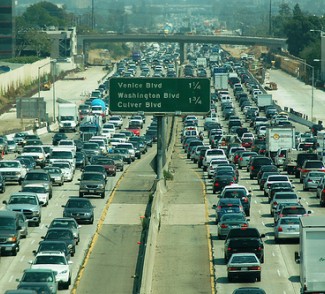
Urban highways are more congested than they were in the past, carrying about double the traffic of 1980 on average —. but widening them isn’t likely to solve it, because vast experience has shown that widening highways encourages more driving, as people shift where they live and work to account for the relative ease of driving. In other words, more roads fuel sprawl and make people more dependent on driving. This phenomenon is called induced demand. Studies have shown, for example, that for each radial highway from a city center decreases the center-city population 10 percent.
“Highways and other transportation infrastructure clearly have the ability to create economic activity in one place at the expense of some other place,” said Turner. “It is less clear that this infrastructure increases overall economic activity.”
So that’s where congestion pricing comes in.
On average U.S. highways carry just a fraction of the 37,000 vehicles per lane per day they could maximally accommodate, Turner says. Rural highways are particularly under-used, carrying about 20 percent of their total capacity, compared with 40 percent on urban highways.
So rather than spending billions to expand highways, Turner argues for policies to “spread travel out over the day.”
“Even slight” diversions of rush hour traffic to other times of day “can have large effects on congestion,” he writes. Congestion pricing on urban highways “should be a policy priority.” Tolls on travel into or through the central business district are currently being discussed in Portland. Virginia and Maryland already use congestion pricing — also known as variable tolling — on highways with great success. (New York City is seeking to use congestion pricing to fund transit improvements, but that system is not designed with highway congestion in mind.)
Real infrastructure improvements need to be made in urban rail, where the average car is 22 years old and has 50 percent more riders per year (about 300,000) than it did in 1992, Turner says
“Urban rail cars are old and heavily used, while the rural interstate is lightly used and is becoming progressively smoother over time,” he writes. “This suggests a decrease in spending on the rural interstate and an increase in spending on urban rail.”
The notion of America’s “crumbling infrastructure” is practically sacrosanct in political discussions. The idea has been advanced primarily by the American Society of Civil Engineers and its famous “report card” rating system. But many people in the civil engineering field are skeptical about claims made in the report. And ACSE has a clear self-interest in more spending on infrastructure.
“Claims about the dilapidation of U.S. transportation infrastructure should be regarded with a critical eye,” says Turner.

Streetsblog has migrated to a new comment system. New commenters can register directly in the comments section of any article. Returning commenters: your previous comments and display name have been preserved, but you'll need to reclaim your account by clicking "Forgot your password?" on the sign-in form, entering your email, and following the verification link to set a new password — this is required because passwords could not be carried over during the migration. For questions, contact tips@streetsblog.org.
More from Streetsblog USA
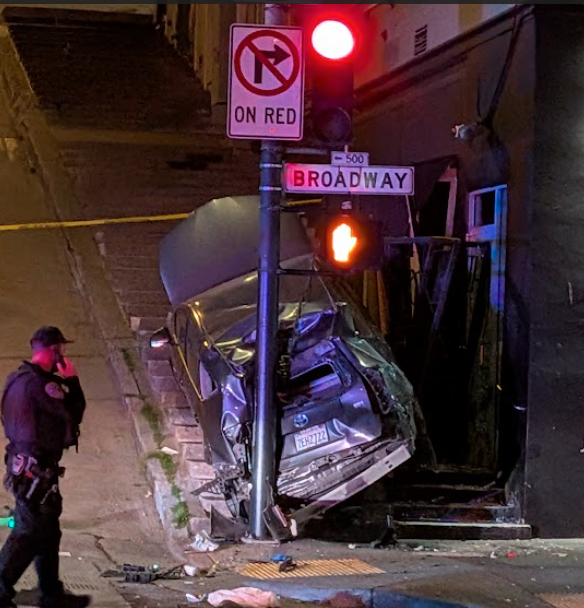
Motorist Careens onto North Beach Sidewalk, Killing Pedestrian
Driver kills pedestrian at another location where a safety project festered
The post Motorist Careens onto North Beach Sidewalk, Killing Pedestrian appeared first on Streetsblog San Francisco.