Safety Officials to Cities: Stop Buying Such Huge Trucks
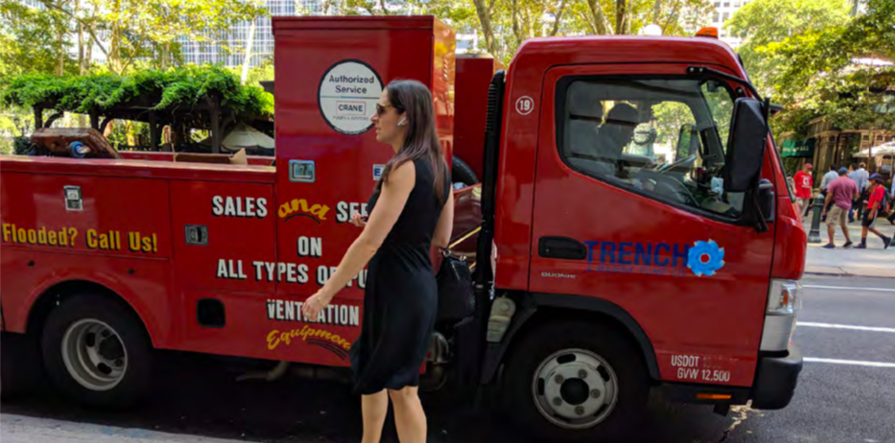
Cities that are serious about achieving Vision Zero have to tackle large truck design.
Garbage trucks, fire trucks, commercial freight trucks, which comprise only four percent of vehicles on the streets, are responsible for almost twice that number of pedestrian fatalities and more than one in 10 bike fatalities, according to a new report from the Volpe Center, a research center at the U.S. Department of Transportation.
The disparity is much worse in major cities, which is why experts are urging urban policymakers to stop buying wide killing machines.
“Choosing vehicles with safer designs is a simple and proven step that any city can take to help stem the rising epidemic of traffic deaths on our streets,” Linda Bailey, executive director of the National Association of City Transportation Officials said in a statement.
The Volpe study offered these recommendations:
Make the vehicles smaller
Smaller trucks stop faster. And they exert less force when they crash. But firetrucks in particular are just getting too big.
“Fire apparatus have grown in size to the point that emergency vehicles were recently exempted from federal truck weight limits,” the research team wrote. That is putting pressure on the nation’s bridges, many of which weren’t designed to handle fire vehicles weighing as much as 160,000 pounds.
The arms race on large vehicles is happening even as fire departments are becoming less diversified in their missions. Only about 5 percent of calls are related to building fires nationally, Volpe reported.
San Francisco recently ordered a firetruck that is 25 rather than 33 feet. It also has a 24-percent smaller turn radius, which makes it more maneuverable, potentially lowering response times. SFFD was able to do that without sacrificing any water pumping capacity, the Volpe report said.
Right now, there are few small firetrucks commercially available in the U.S. But the report suggested that if a handful of cities would band together, they could entice American manufacturers to consider smaller models.
Cab over design
Cab over design means the driver sits over the wheel axel instead of way back behind the nose of the truck. This improves visibility by reducing blind spots.
You can see in this visualization that in a traditional truck, the entire bike lane might be invisible while waiting at an intersection.

But smaller, more maneuverable cab over designs have been successfully utilized in cities like Somerville, Mass. (below) to improve safety.
Additionally, cities can choose to lower the cab to further promote visibility and “help the driver to make eye contact and communicate intent with nearby pedestrians and cyclists.”
Add windows

Read More:
Streetsblog has migrated to a new comment system. New commenters can register directly in the comments section of any article. Returning commenters: your previous comments and display name have been preserved, but you'll need to reclaim your account by clicking "Forgot your password?" on the sign-in form, entering your email, and following the verification link to set a new password — this is required because passwords could not be carried over during the migration. For questions, contact tips@streetsblog.org.
More from Streetsblog USA
Motorist Careens onto North Beach Sidewalk, Killing Pedestrian
Driver kills pedestrian at another location where a safety project festered
The post Motorist Careens onto North Beach Sidewalk, Killing Pedestrian appeared first on Streetsblog San Francisco.