Trip Data Deflates the Dockless Bike-Share Hype
Dockless bike-share burst onto the scene in American cities last year, with lots of hype about “disrupting” urban transportation.
While there’s been no shortage of stories about the untidiness of dockless bike-share, information about how useful the new systems are has been hard to come by.
A new report from the National Association of City Transportation Officials sheds some light on the situation, and so far the performance of the dockless bike-share systems is underwhelming.
1. Dockless bike-share is growing fast, but it’s not getting much use.
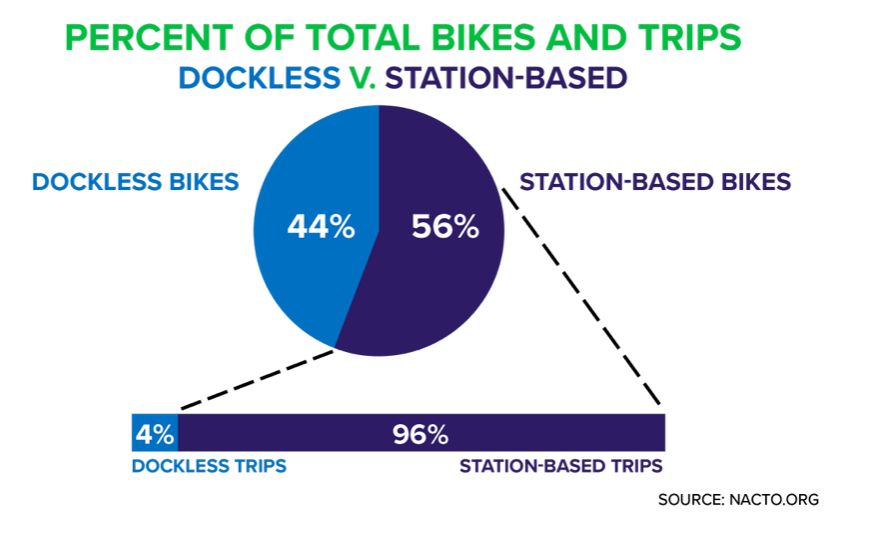
Dockless bike-share companies added 44,000 bikes to American streets in 2017, according to NACTO, compared to 14,000 bikes for station-based systems. In some cities, notably Seattle and Dallas, the scale of dockless bike-share rivals or exceeds the largest station-based bike-share networks in cities like New York and Chicago.
But looking at ridership paints a different picture. Dockless bike-share carried just 4 percent of all bike-share trips in 2017, according to NACTO’s estimates, despite accounting for 44 percent of all shared bikes. On a per-bike basis, station-based systems yielded an average of 1.7 rides per day, compared to 0.3 rides per day for dockless systems.
One qualification: Dockless bike-share companies still don’t make much trip data available. NACTO compiled data on the number of trips when companies made it available. In other cases, companies only shared total mileage, and NACTO extrapolated the number of trips from that.
Keep in mind that the phrase “dockless bike-share” doesn’t capture what distinguishes the new wave of bike-share companies very well. Yes, their systems all operate without stations. But a business model that relies on cheap equipment and low maintenance costs also sets them apart.
It’s possible to provide dockless systems that also have well-built equipment, reliable maintenance, and operations that don’t skimp on rebalancing — and maybe systems like that will get more use. We just haven’t seen one yet, at least not at scale.
2. Large station-based bike-share systems account for an overwhelming majority of trips
Overall bike-share ridership grew 25 percent last year, but only a few cities have bike-share networks that are genuinely useful for transportation. In most places, bike-share networks — whether station-based or dockless — remain skimpy.
Most bike-share trips are still concentrated in four large cities with station-based systems. Together, New York’s Citi Bike, Chicago’s Divvy, Washington’s Capital Bikeshare, and Boston’s Hubway accounted for 74 percent of all American bike-share trips in 2017.
One other system that did see significant growth was Philadelphia’s Indego, which increased ridership 84 percent. Indego is one of several systems operated in partnership with city governments that have been offering discounted memberships to low-income subscribers.
3. Low ridership could spell bigger problems for dockless bike-share
So far, the ridership numbers for dockless bike-share are not exactly reassuring for the long-term viability of the firms, NACTO says. Without stronger uptake, the companies may fade away as quickly as they appeared. Even in China, where dockless bike-share systems do account for a large number of trips, the industry is undergoing convulsions, with high-profile bankruptcies provoking questions about the long-term sustainability of the business model.

Read More:
Streetsblog has migrated to a new comment system. New commenters can register directly in the comments section of any article. Returning commenters: your previous comments and display name have been preserved, but you'll need to reclaim your account by clicking "Forgot your password?" on the sign-in form, entering your email, and following the verification link to set a new password — this is required because passwords could not be carried over during the migration. For questions, contact tips@streetsblog.org.
More from Streetsblog USA
Motorist Careens onto North Beach Sidewalk, Killing Pedestrian
Driver kills pedestrian at another location where a safety project festered
The post Motorist Careens onto North Beach Sidewalk, Killing Pedestrian appeared first on Streetsblog San Francisco.