Instead of a Pedestrian Bridge, How About a Street That Works for Walking, Biking, and Transit?
When a hastily constructed pedestrian bridge collapsed onto Eighth Street at Florida International University, killing six people, it should have been a wake-up call for transportation officials.
In addition to being a fatal failure of engineering and construction, the bridge collapse was a failure of street design and transportation planning by Miami Dade County and Florida DOT. Eighth Street is wide, fast, and deadly, but instead of making the crossing safe for pedestrians, state and county officials opted to build a bridge over it.
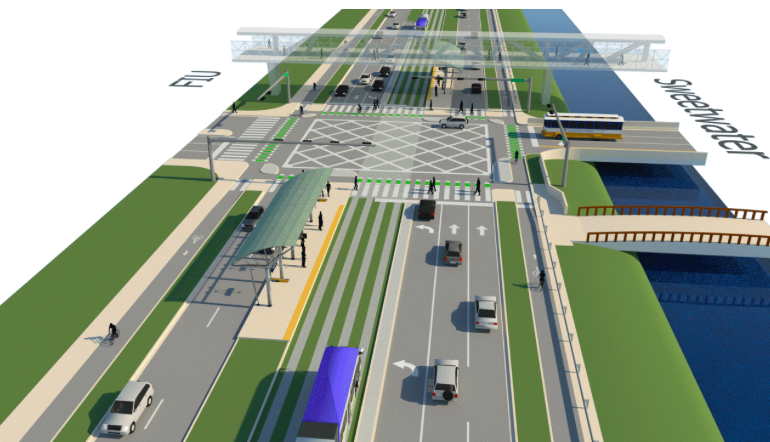
How can car-centric Eighth Street be redesigned as a safe, multi-modal street? Planners Victor Dover and Kenneth García have some ideas.
Writing in Miami’s Community Newspapers, Dover says it’s time to make Eighth Street work for walking:
We are correctly focused right now on the six victims killed under the bridge collapse. But in the last 4 years, more than 2200 crashes occurred along this part of the corridor, and at least 12 other people died in those collisions.
The real purpose of the bridge was to reduce the pesky crosswalks and speed up traffic, to minimize signal phases when motorists would have to wait for people to cross on foot. Meanwhile, the effect of such bridges is to permanently surrender the at-grade pedestrian experience.
Here Dover and García show Eighth Street in its current form, designed solely to facilitate fast driving:
Dover and García propose curbside protected bike lanes and a median busway. Combined, these interventions also calm car traffic and greatly reduce crossing distances for pedestrians:
The Miami Dade Metropolitan Planning Organization considered bus lanes for Eighth Street in 2015, but officials rejected the idea.
Obviously, overhauling the street for transit and safe walking and biking would be a more complicated undertaking than snapping a bridge on top of the road. But the benefits would be much, much greater and would compound over time.
Everything decision surrounding the bridge — from declining bus lanes, to choosing a pedestrian bridge over a road diet, to using a “quick build” process to install the bridge and then stress test it without closing traffic — was about accommodating drivers and not delaying them. It’s time for local planners to move past this failed paradigm.

Read More:
Streetsblog has migrated to a new comment system. New commenters can register directly in the comments section of any article. Returning commenters: your previous comments and display name have been preserved, but you'll need to reclaim your account by clicking "Forgot your password?" on the sign-in form, entering your email, and following the verification link to set a new password — this is required because passwords could not be carried over during the migration. For questions, contact tips@streetsblog.org.
More from Streetsblog USA
Motorist Careens onto North Beach Sidewalk, Killing Pedestrian
Driver kills pedestrian at another location where a safety project festered
The post Motorist Careens onto North Beach Sidewalk, Killing Pedestrian appeared first on Streetsblog San Francisco.