Snapping Together a Better Bus Stop
Bus bulbs and their cousin, the bus island, speed up transit service by positioning the boarding area right next to the travel lane. Buses don’t have to pull in and out of traffic, which saves 5 to 20 seconds per stop, according to the National Association of City Transportation Officials. That can add up to significant time savings over a whole route.
Some cities aren’t waiting to build out bus bulbs in concrete. To get these improvements done faster, they’re using inexpensive snap-in-place plastic platforms made by the Spanish company Zicla.
New York, Pittsburgh, and now Oakland have all experimented with the Zicla product as a way to accelerate implementation of bus bulbs.
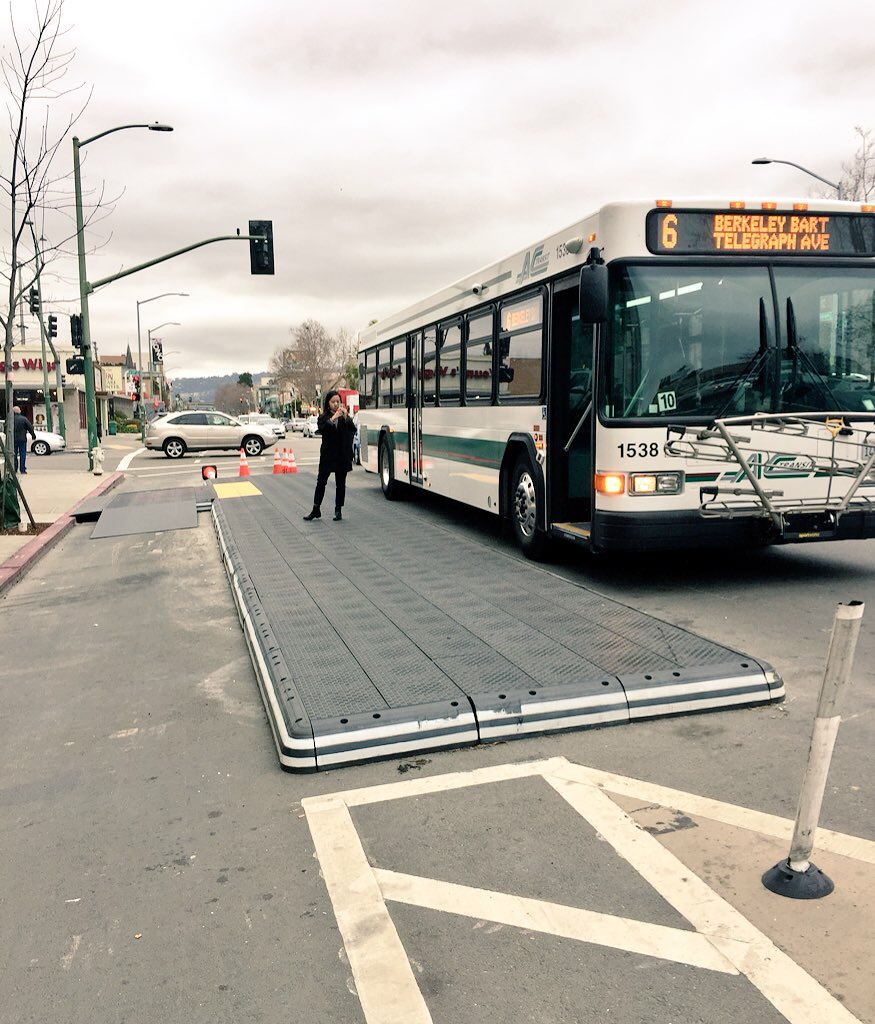
In Oakland, the city added the bus islands along the protected bike lane on Telegraph Avenue to reduce conflicts between cyclists and buses. Without the bus island, cyclists would have to weave around buses during the boarding process.
Instead of spending days or weeks to dig up the street and pour concrete, the modular bus islands take hours to install. “It’s just radically cheaper, you can put it down in a day,” said TransitCenter’s Jon Orcutt. “The unit that you see in the picture from Oakland is about $20,000.”
The Zicla product is ADA-compliant, with a low rise where the bulb meets the sidewalk. As you can see, for the bus island version on Telegraph Avenue, the bulb connects to the sidewalk with a walkway that cyclists ride over via short ramps.
Oakland officials are evaluating the plastic bus islands on Telegraph with an eye toward more widespread implementation “because they’re cheaper and faster to install than concrete,” according to a post by the city on Medium.
Pittsburgh is also using the Zicla product to speed up bus service on Liberty Avenue, a downtown street where a number of bus routes converge. The platforms are part of an 18-month pilot project.
New York City uses them on Utica Avenue in Brooklyn. After the platforms successfully weathered the winter, the city elected to leave them in place past the trial period, Orcutt says.

Read More:
Streetsblog has migrated to a new comment system. New commenters can register directly in the comments section of any article. Returning commenters: your previous comments and display name have been preserved, but you'll need to reclaim your account by clicking "Forgot your password?" on the sign-in form, entering your email, and following the verification link to set a new password — this is required because passwords could not be carried over during the migration. For questions, contact tips@streetsblog.org.
More from Streetsblog USA
Motorist Careens onto North Beach Sidewalk, Killing Pedestrian
Driver kills pedestrian at another location where a safety project festered
The post Motorist Careens onto North Beach Sidewalk, Killing Pedestrian appeared first on Streetsblog San Francisco.