How Dangerous Walking Conditions Disadvantage Women
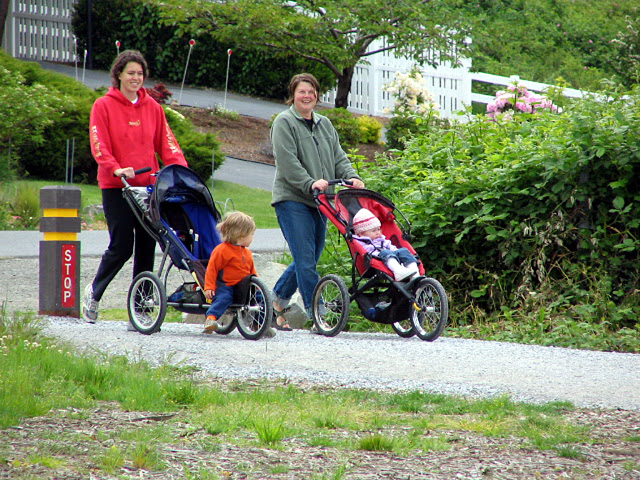
San Diego resident Katie Matchett recently found herself in a position that American women will recognize all too well. She wanted to make a short trip — less than a mile — with four children. But thanks to a lack of safe sidewalk and street crossings, she reluctantly opted to drive instead.
At her blog Where the Sidewalk Starts, Matchett says women’s travel behavior is different than men’s in a number of ways. Women have more reasons to walk or bike, but the hostile street environment we’ve created shifts those trips to cars:
Women make more trips than men, but travel shorter distances. They travel more with children, and their trips are more likely to be household-serving (e.g., shopping, daycare, errands), rather than for work or leisure. Women are also more likely to trip-chain (stop at multiple locations along the way during one trip). In particular for women with young children who haven’t started school, gender drives travel patterns.
In theory, the trips women take the most are ideally suited for walking. Short trips to the school, grocery store, or similar locations should be simple to complete on foot–and in the most walkable neighborhoods, women do walk a lot. However, more often we’ve built walkablility out of our neighborhoods. Our streets lack sidewalks where kids can walking hand-in-hand or be pushed in a stroller. We fail to provide safe, regular crossing points along key routes. We create neighborhoods where stores, schools, and (critically) childcare are too far apart to be accessed on a single walking trip. We fail to consider the design elements (lighting, lack of hidden spaces, etc.) that can deter crime and make women feel safe while walking.
These challenges have a real impact on women’s health. One recent study investigated the physical activity patterns of over 700,000 people in 111 different countries. Using travel data from cell phone records, the researchers developed a measure of activity inequality that quantified the difference between the most physically active and least physically active portions of the population. Not surprisingly, the US appears near the head of the list of least equal countries, topped only by Egypt, Canada, Australia, and Saudi Arabia.
More recommended reading today: America Walks shares yesterday’s webinar about how racial bias in the criminal justice system intersects with walking and biking advocacy. And the Urbanist says Washington state’s plans for a “single-point urban interchange” in Seattle highlights the agency’s low regard for pedestrians and cyclists.

Read More:
Streetsblog has migrated to a new comment system. New commenters can register directly in the comments section of any article. Returning commenters: your previous comments and display name have been preserved, but you'll need to reclaim your account by clicking "Forgot your password?" on the sign-in form, entering your email, and following the verification link to set a new password — this is required because passwords could not be carried over during the migration. For questions, contact tips@streetsblog.org.
More from Streetsblog USA
Motorist Careens onto North Beach Sidewalk, Killing Pedestrian
Driver kills pedestrian at another location where a safety project festered
The post Motorist Careens onto North Beach Sidewalk, Killing Pedestrian appeared first on Streetsblog San Francisco.