Why Can’t We Have Traffic-Calming “3-D” Crosswalks Like Iceland?
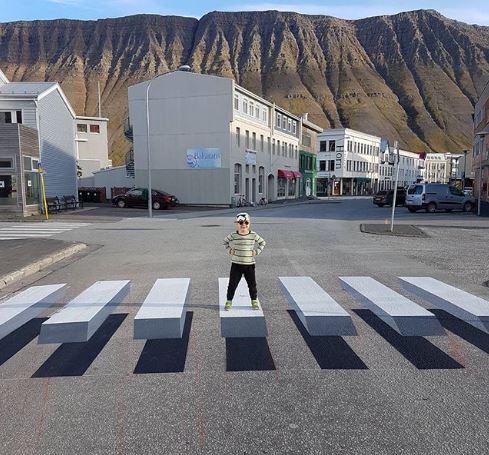
People around the world are fascinated by the 3-D illusion of this painted crosswalk in the small town of Ísafjörður in Iceland. It’s a creative and simple way to get motorists to slow down.
But if you try to make an eye-catching crosswalk design in the United States, the transportation engineering establishment won’t approve. That’s what happened to a group of neighbors in St. Louis who painted their local crosswalks and were told by the city the new markings were a safety hazard.
There’s no good research to support that position, so why do authorities frown at any deviation from standard crosswalk design? The Federal Highway Administration’s guidance outlines the agency’s thinking:
In 2011, the FHWA issued an additional Official Ruling4 that crosswalk art — defined as any freeform design to draw attention to the crosswalk — would degrade the contrast of the white transverse lines against the composition of the pavement beneath it. In deviating from previous Official Rulings on the matter that concluded an increased factor of safety and decreased number of pedestrian deaths were not evident after installation, this 2011 Official Ruling stated that the use of crosswalk art is actually contrary to the goal of increased safety and most likely could be a contributing factor to a false sense of security for both motorists and pedestrians.
Despite the FHWA’s apparent certainty, there is no rigorous empirical evidence that crosswalk art reduces safety for pedestrians.
It would be one thing if the U.S. had an exemplary pedestrian safety record to uphold. Then strict conformity with the “rules” would make good sense. But American streets are dangerous places to walk, and pedestrian fatalities are skyrocketing — rising nearly 50 percent since 2009.
Meanwhile, FHWA is still using discredited studies from 40 years ago to discourage the installation of crosswalks. It’s clear that the flow of car traffic is still prioritized over public safety at the top levels of the American engineering establishment. Instead of overhauling guidelines to reduce the death toll, we get stale guidance that discourages grassroots interventions to make streets safer.
The bottom line: Federal traffic safety officials take conformity with an unsafe system much more seriously than actual safety outcomes.
More recommended reading today: Transportation for America reports that a program that addresses neighborhood public health disparities is under threat in the Trump administration’s heartless budget proposal. And the State Smart Transportation Initiative shares a new tool that can help communities measure walkability.

Read More:
Streetsblog has migrated to a new comment system. New commenters can register directly in the comments section of any article. Returning commenters: your previous comments and display name have been preserved, but you'll need to reclaim your account by clicking "Forgot your password?" on the sign-in form, entering your email, and following the verification link to set a new password — this is required because passwords could not be carried over during the migration. For questions, contact tips@streetsblog.org.
More from Streetsblog USA
Motorist Careens onto North Beach Sidewalk, Killing Pedestrian
Driver kills pedestrian at another location where a safety project festered
The post Motorist Careens onto North Beach Sidewalk, Killing Pedestrian appeared first on Streetsblog San Francisco.