Highway Planners Pause to Consider the Effect of Road Widening on Detroit Neighborhoods
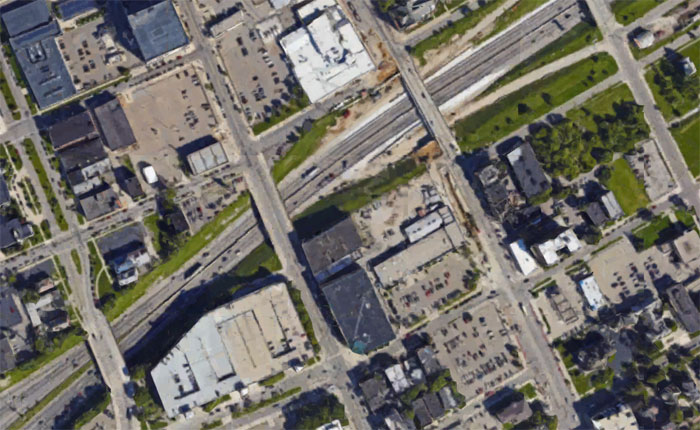
Standard practice for the highway planners at state DOTs is to sacrifice all other concerns at the altar of fast car traffic. Nowhere has the effect been more obviously detrimental than Detroit, where the overbuilt freeway system helped hollow out one of America’s largest cities.
But highway planners in Michigan are starting to listen to people who say they want something different.
Crain’s Detroit reports that Michigan DOT will conduct a fairly major revision of its more-than-a-decade-old plan to repair and widen Interstate 94 through the city. While the plan still calls for adding lanes, the state will no longer widen the right-of-way through urban neighborhoods.
The project also includes several bridges that carry local streets over I-94. Michigan DOT says that in the revised design, these bridges will include better access for walking and biking.
MDOT spokesperson Rob Morosi told Crain’s:
What we’ve heard is that Detroit has changed. (Now there is) a lot of focus on different modes of transportation. What was approved 10 years ago doesn’t fit into what the city and residents want to see in terms of transportation options.
Michigan DOT is taking a step in the right direction here by making an effort to reduce the negative impact of a highway on city neighborhoods. But make no mistake, the project is still a 7-mile road capacity expansion that will add lanes to make it marginally easier for people to commute by single-occupancy car from distant suburbs. There are far better ways to spend transportation dollars in a region where residents rely on a woefully underfunded transit system.
More recommended reading today: BikePortland reports that Oregon Governor Kate Brown has signed two bills to reduce excessive driving speeds and one to hold motorists accountable when they injure people. And the Urban Edge at Rice University highlights a report from Smart Growth that found complete streets policies are on the rise, but mostly in affluent, whiter areas.

Read More:
Streetsblog has migrated to a new comment system. New commenters can register directly in the comments section of any article. Returning commenters: your previous comments and display name have been preserved, but you'll need to reclaim your account by clicking "Forgot your password?" on the sign-in form, entering your email, and following the verification link to set a new password — this is required because passwords could not be carried over during the migration. For questions, contact tips@streetsblog.org.
More from Streetsblog USA
Motorist Careens onto North Beach Sidewalk, Killing Pedestrian
Driver kills pedestrian at another location where a safety project festered
The post Motorist Careens onto North Beach Sidewalk, Killing Pedestrian appeared first on Streetsblog San Francisco.