Urban Designers Take a Do-It-Yourself Approach to Taming Houston’s Extra-Wide Streets

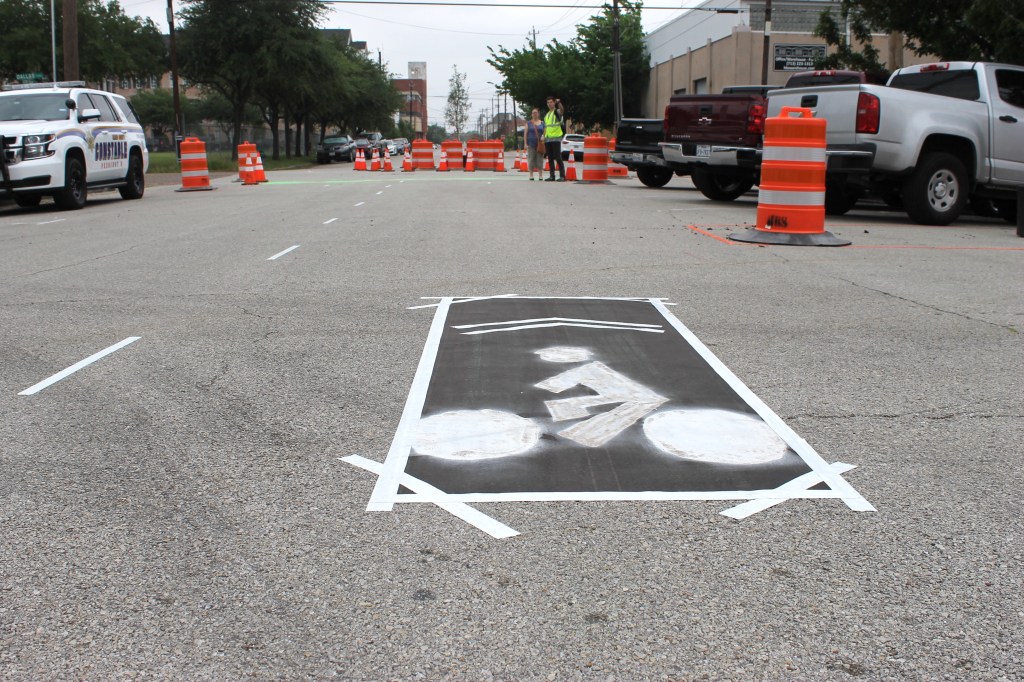
Impatient at the slow rate of change on Houston’s streets, advocates and urban designers took it upon themselves to tame some of their city’s wide roads — and are promising to come back for a second round soon.
The EaDo neighborhood, or East Downtown Houston, sits across an elevated interstate from downtown. Low-slung industrial buildings have recently given way to new apartments close to a pair of light rail lines. “It’s transitioning to a more residential neighborhood with retail,” says Raj Mankad, editor of Cite, a quarterly publication of the Rice Design Alliance. “These wide streets don’t have a very large traffic burden on them.”
So in January, the Rice Design Alliance organized a charrette in which 15 teams presented ideas on how to turn EaDo’s streets into more people-friendly places. A panel comprised of local officials and academics picked the winning team, from architecture and planning firm Asakura Robinson’s Houston office.
“So often with these charrettes, nothing ever materializes. So we took it on ourselves to say, ‘Not this time,’” says Taylor McNeill, associate designer at Asakura Robinson.
McNeill and his teammates reached out to groups including Trees for Houston, Bike Houston, and Keep Houston Beautiful to stage a one-day intervention on April 29 along Live Oak Street, with the backing of the East Downtown Management District, which provided liability insurance and helped secure a permit for the event.
Using traffic cones, chalk, and tape, the group changed the street’s layout, writes Lauren Murray at Cite:
This low-cost intervention created a roundabout to increase driver awareness, a median that could be turned into a pop-up market, [and] narrower street lanes to calm traffic… There was an art installation, street chalk, and free breakfast tacos.
The police were on hand, as was a local council member. At the end of the day, most of the changes had to be packed up, but the tape remained on the road, subtly slowing drivers for weeks.
“To my knowledge it’s still there, several weeks later, and people continue to park in parking spots that were marked in tape, and people are following narrower lane widths,” Mankad says. “The very barest of tactical interventions — just the tape! — could change peoples’ behaviors.”
Organizers hope the one-day intervention can help spur a broader change in the way Houston designs its streets.
“We’ve had this ‘complete streets’ executive order in Houston for a couple years now and we haven’t seen a lot of built results from that, so there’s a lot of impatience and even skepticism,” says Mankad.
“They’re just rebuilding the streets exactly the way they were, and there’s really no discussion from policymakers about what the streets could be,” added McNeill, who wants to continue pushing until people-friendly designs are incorporated into the city’s standard practices. Staff in the public works department has been supportive of the demonstrations in EaDo, giving him reason to be hopeful.
Asakura Robinson and the East Downtown Management District are planning on a second round of do-it-yourself interventions that could last for more than one day, McNeill said, and they want to ask residents and local business owners about the types of changes they’d like to see.
“We don’t want this to be an architect on a white horse saving the day,” McNeill said. “We need the community to guide us. That’s the big thing.”

Read More:
Streetsblog has migrated to a new comment system. New commenters can register directly in the comments section of any article. Returning commenters: your previous comments and display name have been preserved, but you'll need to reclaim your account by clicking "Forgot your password?" on the sign-in form, entering your email, and following the verification link to set a new password — this is required because passwords could not be carried over during the migration. For questions, contact tips@streetsblog.org.
More from Streetsblog USA
Motorist Careens onto North Beach Sidewalk, Killing Pedestrian
Driver kills pedestrian at another location where a safety project festered
The post Motorist Careens onto North Beach Sidewalk, Killing Pedestrian appeared first on Streetsblog San Francisco.