This Nearly-Empty Indianapolis Parking Garage Is an Epic Waste of Public Money

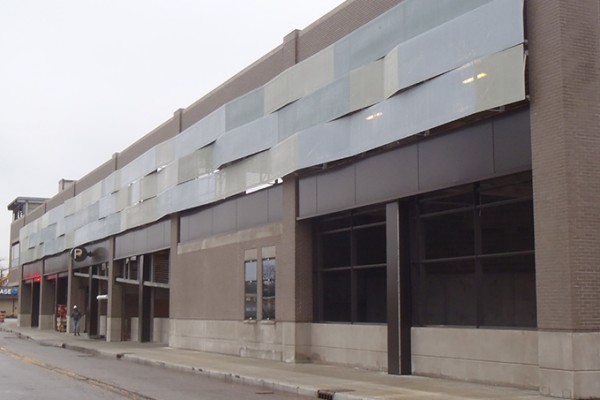
Subsidized parking garages frequently turn into money-losing concrete bunkers on land better suited for something more productive than car storage. The Broad Ripple parking garage in Indianapolis, a pet project of former mayor Greg Ballard, is a spectacular example.
“It goes without saying that the garage is a white elephant for the City — possibly one of the biggest black eyes for the Ballard administration,” Eric McAfee writes at UrbanIndy. “It has turned into a burden for the owner as well.”
Broad Ripple is a hotspot for bars, restaurants, and shopping on the north side of Indianapolis. Plans are underway for a 35-mile bus rapid transit line connecting with downtown, but for now most people drive to Broad Ripple, leading to constant complaints about a lack of parking. So in 2011, the city gave Keystone Group $6.35 million in public funds — generated through a parking meter privatization deal — to build a $15 million, three-story, 350-space garage, which opened in 2013 on the site of a shuttered gas station.
“If the key to economic development can be boiled down to having enough places for people to park, Broad Ripple is in for good things,” the local news gushed at the time. But the assumption that a new garage would be a good use of city funds turned out to be very, very wrong.
For starters, the garage charged twice as much ($2/hour) as on-street meters, and nearby residential streets never got a permit program, so people kept parking where they always had instead of ponying up for the garage. A local TV station reported that, five months after opening, the garage was just 5.5 percent full on average, and only 20 percent full during weekend evenings, when Broad Ripple is busiest.
A year after opening, the garage dropped its rate to match the meters. It hasn’t helped much: On his recent visit to the garage, McAfee found it was still mostly empty. In an attempt to cut losses, last year the owner got permission to lease out the garage’s top floor to a car rental operator.
The garage’s first floor contains 25,000 square feet of retail, which the developer has also struggled to fill. Rents for the new retail space are reportedly well above the neighborhood average. A chain hair salon and a Michigan-based brewpub have opened, but two other tenants — a chain sandwich store and a national frozen yogurt shop — have chosen not to renew their leases, McAfee reports. To fill the space, Keystone has turned to the merchandise shop for the local professional soccer team — which is owned by Keystone CEO Ersal Ozdemir.
McAfee writes:
In other words, the CEO of Keystone is spinning off some of his own equity to help pay off construction loans for the garage — loans that the City already helped reduce by over 6 million… If he hadn’t received this generous subsidy, would he have sunk all his money into such a poor design? If he had sought a market-driven method of adding vibrancy to a key intersection in Broad Ripple, wouldn’t a mixed-use product with housing or offices on a few upper floors have helped the retail?
With mistakes cast in concrete, Indianapolis probably won’t clear this site for a different type of development anytime soon. But the Broad Ripple garage can serve as an example to other cities that public spending on parking garages is a losing strategy.

Read More:
Streetsblog has migrated to a new comment system. New commenters can register directly in the comments section of any article. Returning commenters: your previous comments and display name have been preserved, but you'll need to reclaim your account by clicking "Forgot your password?" on the sign-in form, entering your email, and following the verification link to set a new password — this is required because passwords could not be carried over during the migration. For questions, contact tips@streetsblog.org.
More from Streetsblog USA
Motorist Careens onto North Beach Sidewalk, Killing Pedestrian
Driver kills pedestrian at another location where a safety project festered
The post Motorist Careens onto North Beach Sidewalk, Killing Pedestrian appeared first on Streetsblog San Francisco.