Attempting to Gauge the Impact of “Near-Miss” Incidents on Houston’s Streets

We’ve all had this experience while walking or biking — someone cutting us off, or swerving, leaving us catching our breath and thinking, “That was close.” Close encounters, just inches away from being a collision, have a big impact on how we think about street safety, but they’re not well understood, since they’re rarely, if ever, reported. A new report out of Houston attempts to gauge the impact of these “near-miss” incidents.
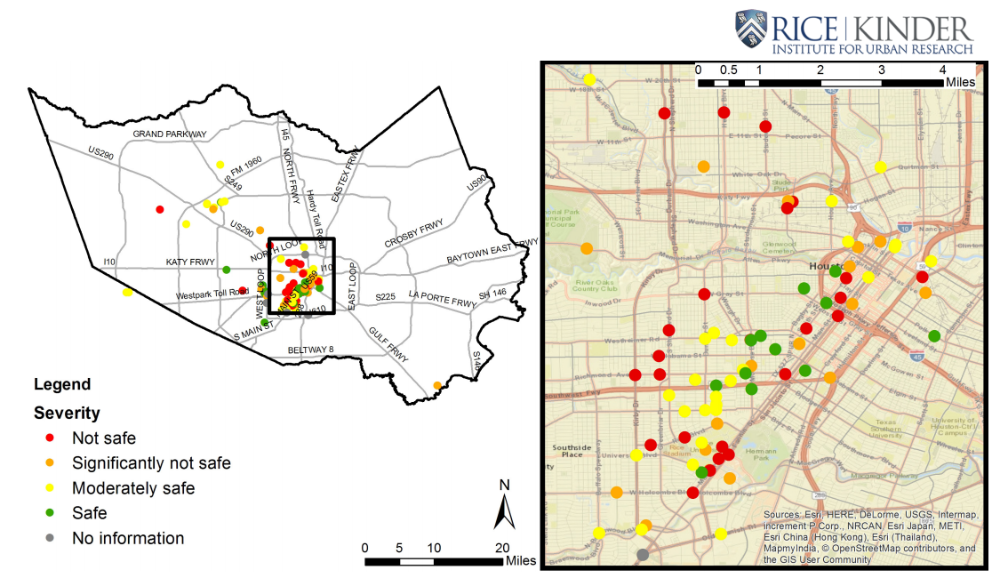
The report, from Rice University’s Kinder Institute for Urban Research, tabulated 133 near-miss incidents reported by volunteers over the course of a week in March. More than two-thirds were near-misses between cyclists and car drivers, while about one in three were between pedestrians and drivers.
The incidents included aggressive verbal confrontations by drivers. One man said he was crossing with the signal when a driver turned his vehicle at him and yelled, ‘Get a job!’ A female cyclist said a driver honked and yelled at her to get on the sidewalk. Even when a near-miss doesn’t involve verbal abuse, people on the receiving end are often left shaken and worried for their safety, the report notes.
These types of near-miss encounters are much scarier at high speeds, so streets must also be designed to keep speed in check. “We also need to think about how much our street design contributes to that,” says Dian Nostikasari, a Kinder Institute research fellow, in a video about the report. “The combination of the speed and other things that could be very distracting could make you miss the presence of other road users.”
Houston’s built environment plays a big role in the types of near-misses that occur, says Kyle Shelton, the Kinder Institute’s director of strategic partnerships. “Here there are a lot of pull-out near-misses — people pulling out of driveways or parking lots without looking,” he told Streetsblog.
Stress from repeated near-misses could also change the routes people take, warping the statistics that planners rely on to determine the danger on a given street, the Kinder Institute says:
The near-misses that bicyclists and pedestrians sometimes experience may affect their future travel decisions and prompt them to avoid roads they know are dangerous. That, in turn, could reduce the number of collisions at particular intersections. On paper, that could make an area seem safe, even if they aren’t. Thus, those areas could be overlooked if decisions about road safety are based crash incidents alone.
The Kinder Institute’s survey relied on volunteers and covered all of Harris County — an approach that has its drawbacks. “Although people who participated in our study have a variety of socio-economic profiles, most are people who bike and tended to be white, older and professional individuals,” the report said, with reported incidents concentrated near downtown.
For future research, Shelton is looking to broaden the range of people involved, while focusing on a specific geographic area to generate more rigorous data.
Ultimately, though, the nature of near-misses makes the problem a difficult one to measure. “A big part of the struggle is how to collect the data,” says Shelton. “There’s no ideal.”

Read More:
Streetsblog has migrated to a new comment system. New commenters can register directly in the comments section of any article. Returning commenters: your previous comments and display name have been preserved, but you'll need to reclaim your account by clicking "Forgot your password?" on the sign-in form, entering your email, and following the verification link to set a new password — this is required because passwords could not be carried over during the migration. For questions, contact tips@streetsblog.org.
More from Streetsblog USA
Motorist Careens onto North Beach Sidewalk, Killing Pedestrian
Driver kills pedestrian at another location where a safety project festered
The post Motorist Careens onto North Beach Sidewalk, Killing Pedestrian appeared first on Streetsblog San Francisco.