Trump’s Bid to Insert Immigration Status Into Census Is an Attack on Cities
Combining the Trump administration’s anti-immigrant fixation and its war on data, an upcoming executive order includes a provision requiring the Census to ask about immigration status, the Washington Post reports. Such a change would affect everyone who lives in cities, depressing the share of federal resources distributed to urban areas and sapping their electoral power as well.
The Census has made a practice of avoiding immigration status for good reason — the question scares people away from participating and would lead to undercounting. A late bid by GOP Senators David Vitter and Bob Bennett to add the question before the 2010 Census was rejected.
Audrey Singer, an immigration expert with the Urban Institute, sees the policy as a deliberate attack on areas with a large share of undocumented immigrants. “The intended effect is probably to intimidate people so that places with a high allocation of immigrants would receive a smaller count and that would affect the amount of funding those places receive,” she said. “They haven’t said what they want to do but that’s what the effect would be.”
The undercounting effect would not be limited to undocumented immigrants, says Singer. Immigrants with citizenship or resident status have also been hesitant to participate, something the Census Bureau works hard to combat.
“A lot of effort has been put in to make sure that people aren’t intimidated,” said Singer, “so that we could all make sure the data was as accurate as we want it to be.”
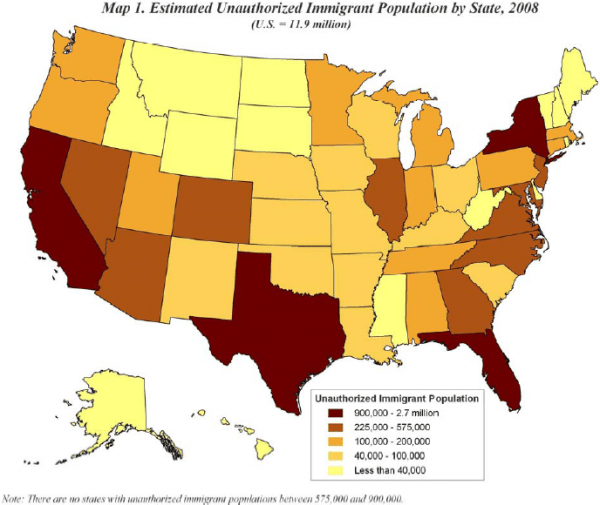
Undercounting immigrants would disproportionately affect cities. According to Pew Research, 94 percent of undocumented immigrants live in metropolitan areas (compared to 80 percent of U.S. born residents), and they are concentrated in large cities specifically, said Singer.
A variety of federal resources are distributed based on Census data. School funding and disaster relief, for example, are allocated according to population. Population factors into federal transportation grants too. The Federal Transit Administration administers 11 grant programs that use a population-weighted formula.
Undercounting would also shift the levers of political power in a way that disadvantages urban areas and states with high numbers of both documented and undocumented immigrants. Pew estimated that 2.7 million undocumented immigrants were living in California in 2008, the largest population in any state. More than half a million undocumented immigrants live in New York City.
If the Census starts asking about immigration status, everyone who lives in these places would be penalized in the process of drawing Congressional districts, further entrenching the structural political disadvantage of urban areas in the United States.

Read More:
Streetsblog has migrated to a new comment system. New commenters can register directly in the comments section of any article. Returning commenters: your previous comments and display name have been preserved, but you'll need to reclaim your account by clicking "Forgot your password?" on the sign-in form, entering your email, and following the verification link to set a new password — this is required because passwords could not be carried over during the migration. For questions, contact tips@streetsblog.org.
More from Streetsblog USA
Motorist Careens onto North Beach Sidewalk, Killing Pedestrian
Driver kills pedestrian at another location where a safety project festered
The post Motorist Careens onto North Beach Sidewalk, Killing Pedestrian appeared first on Streetsblog San Francisco.