All-Door Boarding Can Save Time for Bus Riders — If Transit Agencies Embrace It
Here’s a simple way to make bus trips faster: Let riders board at any door.
All-door boarding can speed up heavily-used bus routes and improve customer satisfaction, according to research led by Ahmed El-Geneidy at McGill University in Montreal [PDF]. But transit agencies have to commit to the new policy to fully realize the benefits.
The time that buses spend stopped while passengers board and exit (“dwell time”) accounts for 9 to 26 percent of a typical bus journey, according to El-Geneidy. All-door boarding reduces this delay.
Empirical research has found that all-door boarding can save significant time for bus riders, especially on busy routes. When all-door boarding and off-board fare collection were introduced on the New York City route with the most ridership, for instance, shorter dwell times were responsible for speeding bus trips 8 percent.
El-Geneidy and his team found a smaller effect on the 121 route in Montreal, attributing a 1.2 percent improvement in travel times to an all-door boarding pilot. There were a few shortcomings in the pilot that explain the underwhelming results.
Montreal’s pilot applied only to riders with unlimited passes, unlike typical all-door boarding systems, which apply to every passenger. The transit agency also appears to have communicated the pilot poorly. Some customers complained that drivers didn’t open the rear doors. At stops where three or more passengers boarded, the vast majority (88 percent) continued to board at the front door, and those passengers were all required to verify payment.
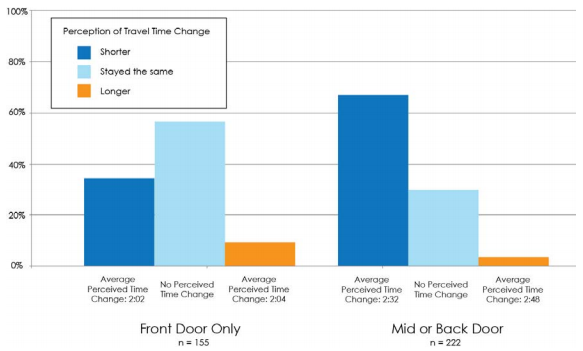
The bus riders who did take advantage of the all-door policy were pleased with it. In a survey of 450 passengers, 67 percent of people who entered at the middle or rear doors perceived a decrease in travel time, compared to 34 percent of passengers who boarded at the front.
Some transit agencies are hesitant to use all-door boarding out of concern that it will encourage fare evasion. But experience has shown those fears are overblown. Ottawa and San Francisco, for instance, both use all-door boarding and have average fare evasion rates. Transit officials who have successfully enacted the switch to all-door boarding say agency priorities have to change from preventing fare evasion, to creating a fare system that results in better service for riders.

Streetsblog has migrated to a new comment system. New commenters can register directly in the comments section of any article. Returning commenters: your previous comments and display name have been preserved, but you'll need to reclaim your account by clicking "Forgot your password?" on the sign-in form, entering your email, and following the verification link to set a new password — this is required because passwords could not be carried over during the migration. For questions, contact tips@streetsblog.org.
More from Streetsblog USA
Motorist Careens onto North Beach Sidewalk, Killing Pedestrian
Driver kills pedestrian at another location where a safety project festered
The post Motorist Careens onto North Beach Sidewalk, Killing Pedestrian appeared first on Streetsblog San Francisco.