Buffalo Becomes First Major U.S. City to Eliminate Parking Minimums
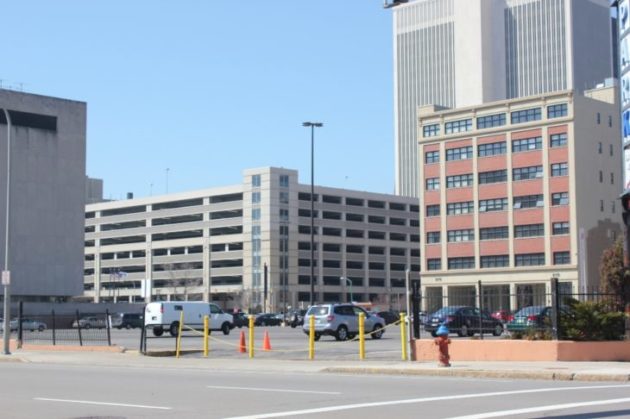
In a major breakthrough for walkable cities, Buffalo, New York, has adopted a new zoning code that eliminates parking minimums.
Since the 1940s, parking minimums have required developers to include a base number of spots, with the amount of parking depending on the type of building. These rules subsidize parking and driving to the detriment of walking and transit. Like many cities, Buffalo is scarred by parking lots and pocked with garages built to satisfy the mandates.
Some American cities are taking measures to roll back minimums in downtowns and other limited areas. Buffalo has gone much further, eliminating them citywide. The move is expected to improve the market for development in Buffalo, which hollowed out during the decades when the region sprawled and the city planned for cars, rather than people.
Robert Steuteville at the Congress for New Urbanism’s Public Square blog explains how this change and a number of others included in the code will benefit Buffalo:
Buffalo became the third major US city to adopt a form-based code (FBC) for the entire city, after Miami and Denver. Many other cities and towns have adopted FBCs for portions of the municipality — the Codes Study counts 362. The Green Code, like other form codes, focuses on regulating urban form rather than separation of uses. In doing so, these codes are designed to improve the public realm — making it more human-scale and pedestrian friendly.
Buffalo’s code breaks new ground in that it eliminates minimum off-street parking requirements citywide. “Many cities have selectively eliminated minimum parking requirements, such as Rochester, which eliminated them downtown. But Buffalo will be the first in the United States to eliminate minimum parking requirements citywide,” reports The Buffalo News. It will stop forcing developers to build parking lots that damage walkability and let the market decide how much parking to provide.
The elimination of minimum parking requirements will make some projects more financially feasible, and the transparency and predictability of the Green Code should also encourage builders once they get used to the new system.
The Green Code addresses street design in a meaningful way. Also from The Buffalo News: “The public will now have more say in how streets are designed. Improvements in the right of way will be reviewed for the first time as part of the planning board review process.”
What we’re also reading this morning: Green City Blue Lake explains why opening up Public Square to buses in Cleveland would benefit everyone. The Bicycle Coalition of Greater Philadelphia reports that people walking and biking now account for half of the city’s traffic deaths. And Daniel Kay Hertz digs into data on declining Chicago bus ridership and finds that data from a single month has skewed the numbers.

Read More:
Streetsblog has migrated to a new comment system. New commenters can register directly in the comments section of any article. Returning commenters: your previous comments and display name have been preserved, but you'll need to reclaim your account by clicking "Forgot your password?" on the sign-in form, entering your email, and following the verification link to set a new password — this is required because passwords could not be carried over during the migration. For questions, contact tips@streetsblog.org.
More from Streetsblog USA
Motorist Careens onto North Beach Sidewalk, Killing Pedestrian
Driver kills pedestrian at another location where a safety project festered
The post Motorist Careens onto North Beach Sidewalk, Killing Pedestrian appeared first on Streetsblog San Francisco.