How Job Sprawl Robs People of Time, Money, and Economic Opportunity
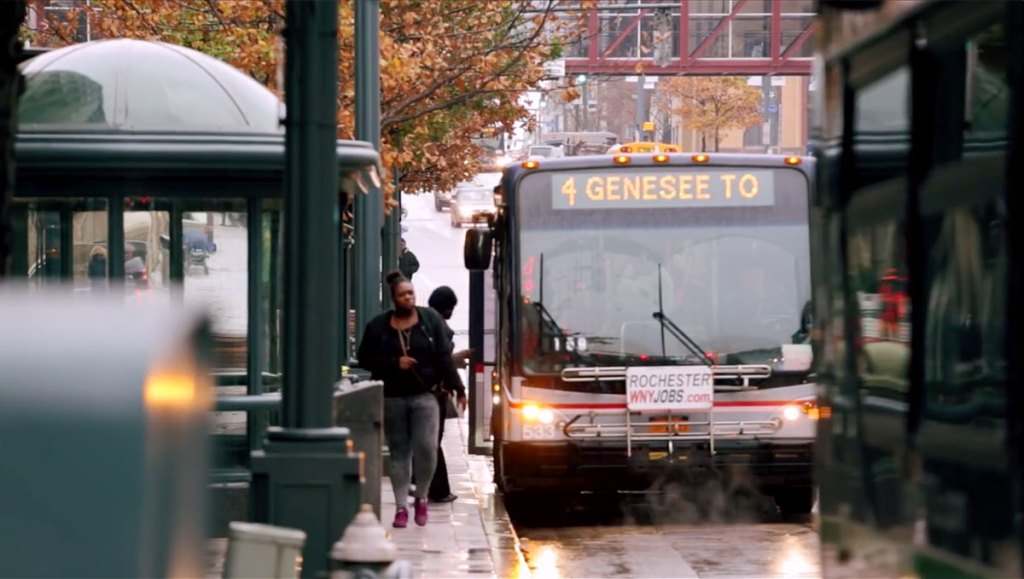
What’s the cost of a long commute? If you’re struggling to make ends meet, spending hours each day just to get to work not only costs you time, it can also be a major barrier to economic mobility.
In Rochester, New York, the advocacy group Reconnect Rochester has been taking a close look at the 7,500 local workers who commute by bus. These commuters make, on average, about $15,000 per year compared to car commuters’ average of $30,000.
And compared to other upstate New York cities, Rochester bus riders are more likely to have very long trips to work — nearly a third contend with commutes that take over an hour each way.
Reconnect Rochester compares how two commute scenarios to similar jobs might affect life opportunities very differently:
Imagine you are a city resident who resides in the Beechwood neighborhood just northeast of downtown. You work 9am — 5pm at a store in Marketplace Mall and make $10 an hour. To arrive punctually, you must board the route 33 at 7:34 am and then transfer to the route 24 at the transit center at 8 am. This bus gets you to Marketplace Mall at 8:34 am, almost a half hour early but the next closest option is arriving at 8:56 am and you know you’ll be late due to the walk. According to Google Maps, you’ve just spent over 1 ½ hours to travel around 12 miles (at a whopping speed of 8 mph — if you are fit you can bike there faster). Your way home is a bit easier. If you can leave right at 5 pm, you can board a 5:10 pm bus and arrive back home at 6 pm. Your evening commute is 50 minutes. Together you’ve spent 2 hours and 20 minutes in commute, or 3.5 times longer in commute than the average regional resident does.
Let’s imagine how this commute effectively reduces your hourly wage and compare that wage to a hypothetical job at the Sibley Building in downtown, where you’d experience closer to the regional average commute time via a bus commute [results shown in above graph].
This long commute is not just a nuisance, it is a real barrier that prevents upward economic mobility.
This time spent commuting does not just reduce your effective earnings, it crowds out time available to do other things. You could be spending time with your kids, taking classes, or even picking up additional shifts at work. It seems reasonable to assume that more people would have jobs if it took less time to get to work.
What we’re also reading today: Good news from Bike Portland, which reports that the Oregon State Senate is considering increasing penalties for distracted driving to make them on par with drunk driving. And The Political Environment explains how Milwaukee was able to secure a streetcar, despite strong hostility to urban transit at the state level.

Read More:
Streetsblog has migrated to a new comment system. New commenters can register directly in the comments section of any article. Returning commenters: your previous comments and display name have been preserved, but you'll need to reclaim your account by clicking "Forgot your password?" on the sign-in form, entering your email, and following the verification link to set a new password — this is required because passwords could not be carried over during the migration. For questions, contact tips@streetsblog.org.
More from Streetsblog USA
Motorist Careens onto North Beach Sidewalk, Killing Pedestrian
Driver kills pedestrian at another location where a safety project festered
The post Motorist Careens onto North Beach Sidewalk, Killing Pedestrian appeared first on Streetsblog San Francisco.