Seattle’s New Park-and-Rides Cost a Fortune But Won’t Move Many People
Seattle area voters will vote this November on a $53 billion transit expansion package. But along with new light rail lines stretching across the region, Seattle will also be getting a publicly owned parking empire.
In total, the plan calls for $661 million in spending on parking at transit stations. At an astounding $80,000 per stall, that will fund 8,300 parking spots.
Zach Shaner at Seattle Transit Blog notes that with 18,000 parking spaces already operated or planned by Sound Transit, the system will have about 26,000 stalls when complete. He set out to visualize all that parking and created this excellent map:

Despite all the space and money these parking spaces will consume, Shaner writes, they won’t serve a large share of light rail riders, because “parking fundamentally can’t scale”:
The system we’d get would be similar to DC Metro in many respects, fully tunneled and zero parking in the urban core, fully traffic-separated, and with both poor land use and gobs of parking on the exurban periphery. Like DC Metro, there would be the occasional urban-ish station, such as Downtown Redmond. Unlike DC, we’d have historic cities (Everett/Tacoma) anchoring the ends of the lines. The scope of our Everett-Tacoma spine would be unprecedented, equal to straightening out DC’s Red Line and then doubling its length.
The dual nature of our system is clear from its parking provision, with a genuinely urban subway that becomes interurban, parking-fed commuter rail on the periphery. From a current or transitional land use perspective, this makes some sense. But it bodes poorly for the suburban TOD that is the main hope for filling the suburban trains off-peak.
Lastly, this further shows how parking fundamentally can’t scale. The 26,000 total parking stalls are less than just the ridership growth from ULink’s two stations. If every stall were taken and assuming 1.5 people per car, the resulting 40,000 people would be less than 10% of projected ridership. Those 40,000 riders would only fill 50 crushloaded 4-car trains, which at 6-minute headways on 3 lines would mean roughly 1.5 hours worth of capacity every morning per line, with lots still full as early as 7:30 a.m.
Elsewhere on the Network today: Rebuilding Place in the Urban Space notes the failure of the Republican Party to develop an urban agenda. And Columbus Underground reports that transit advocates are pleading with city leaders not to dismiss transit in favor of self-driving cars.

Read More:
Streetsblog has migrated to a new comment system. New commenters can register directly in the comments section of any article. Returning commenters: your previous comments and display name have been preserved, but you'll need to reclaim your account by clicking "Forgot your password?" on the sign-in form, entering your email, and following the verification link to set a new password — this is required because passwords could not be carried over during the migration. For questions, contact tips@streetsblog.org.
More from Streetsblog USA
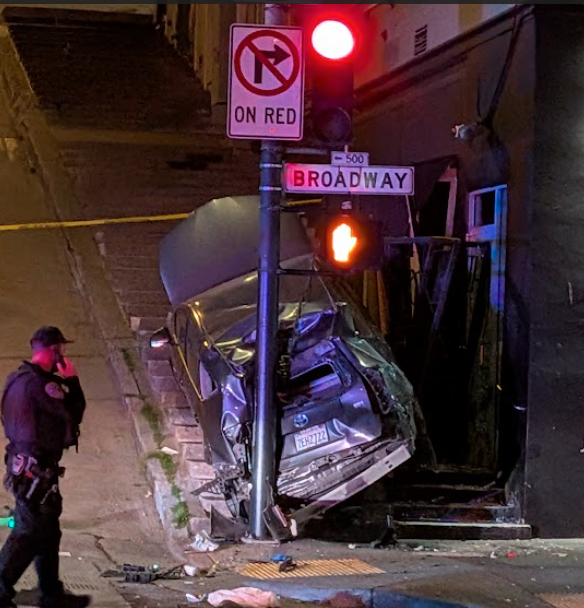
Motorist Careens onto North Beach Sidewalk, Killing Pedestrian
Driver kills pedestrian at another location where a safety project festered
The post Motorist Careens onto North Beach Sidewalk, Killing Pedestrian appeared first on Streetsblog San Francisco.