Will Barcelona’s “Superblocks” Proposal Work Well for Transit?

Barcelona is making waves with plans to test a concept it’s calling “superblocks.” The idea is to create nine-block squares of “citizen spaces” — about 400 meters on each side — where cars would be limited. Unlike the widely derided superblocks of the urban renewal era, Barcelona’s would be explicitly designed to preserve the street grid for walking and biking — only motor vehicle through traffic would be discouraged.
City officials have identified five neighborhoods where the superblock concept will be tested. The streets inside each superblock would be close to car-free. Local motor vehicle traffic will be allowed at very low speeds (under 10 KPH) and so would emergency vehicles. Surface parking would be prohibited.
Officials believe this arrangement of streets can help Barcelona achieve its goal of reducing traffic by 21 percent. It’s part of a broader plan that also calls for 300 kilometers of new bike infrastructure.
Relieved of the obligation to move motor vehicle through traffic and store cars, the streets would be freed up for public space, walking, and biking. One question the plan raises, however, is how it would affect transit.

City officials say buses will be routed along the major thoroughfares outside the superblocks, and stops will be adjusted so “no one is more than 300 meters from a bus stop,” according to the Guardian. The city is also planning to change bus service so average wait time drops from 13 minutes. The reimagined bus network will make it possible to make nearly any trip “with just one transfer,” Salvador Rueda, one of the Barcelona officials behind the project, told the Guardian.
It’s not clear, however, whether buses will get priority lanes or have to slog through additional car traffic.
And if buses only travel in one direction, as the diagram indicates (most streets in Barcelona are one-way), that could pose major problems too, says transit expert Jarrett Walker.
“One-way splits,” as they’re called, reduce access to transit. Fewer people can conveniently walk to transit if there’s a significant distance between each direction of service on the same route.
One-way splits separated by 400 meters would be “terrible for transit,” Walker told Streetsblog. “You can only use transit if you can walk to both directions of service.”

Read More:
Streetsblog has migrated to a new comment system. New commenters can register directly in the comments section of any article. Returning commenters: your previous comments and display name have been preserved, but you'll need to reclaim your account by clicking "Forgot your password?" on the sign-in form, entering your email, and following the verification link to set a new password — this is required because passwords could not be carried over during the migration. For questions, contact tips@streetsblog.org.
More from Streetsblog USA
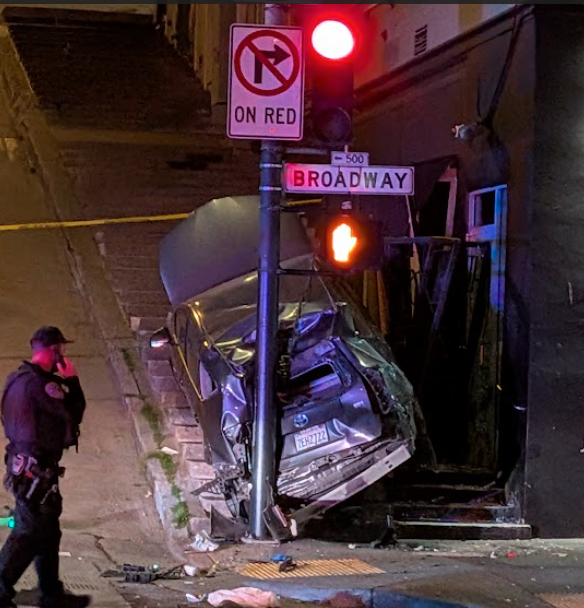
Motorist Careens onto North Beach Sidewalk, Killing Pedestrian
Driver kills pedestrian at another location where a safety project festered
The post Motorist Careens onto North Beach Sidewalk, Killing Pedestrian appeared first on Streetsblog San Francisco.