Here’s What a Billion-Dollar Interchange Expansion Looks Like

In case you were wondering what a $1.1 billion highway interchange looks like, feast your eyes on this rendering from the Georgia Department of Transportation.
In an effort to “ease congestion” on this confluence of highways north of the city, Georgia will spend three-and-a-half years widening about four miles of I-285 and about one mile of SR 400, reconfiguring the place where they merge, rebuilding flyover ramps, and widening access roads into this gargantuan tangle of roadways. The interchange carries about 461,000 vehicles a day.
Governor Nathan Deal called it a “crucial economic engine.” Curbed Atlanta called the project an “orchestrated traffic jam” that is likely to be congested again by the time it is finished.
The cost for this interchange, through the sprawling Atlanta suburb of Sandy Springs, is so large, Georgia officials couldn’t even come close to assembling the money through the usual public funding channels. Instead the state proceeded with private financing to fill the $610 million gap. But private financing is not cheap — the additional cost helps explain why the price tag has ticked up from initial estimates of $650 million to $1.056 billion over the last few years.
Under the revised financing plan, the state will still be paying for this project in 2027, at which point it will make a final balloon payment of $62 million, a figure that is equal to about 20 percent of Georgia DOT’s current annual capital budget, points out the Southern Environmental Law Center.
So this road expansion will constrain Georgia’s ability to invest in transit and other alternatives to driving long after it gets jammed with cars again (since more roadway space will generate more traffic).
According to GDOT, environmental studies found “no significant impact” for this project, which goes to show how meaningless those studies can be.

Read More:
Streetsblog has migrated to a new comment system. New commenters can register directly in the comments section of any article. Returning commenters: your previous comments and display name have been preserved, but you'll need to reclaim your account by clicking "Forgot your password?" on the sign-in form, entering your email, and following the verification link to set a new password — this is required because passwords could not be carried over during the migration. For questions, contact tips@streetsblog.org.
More from Streetsblog USA
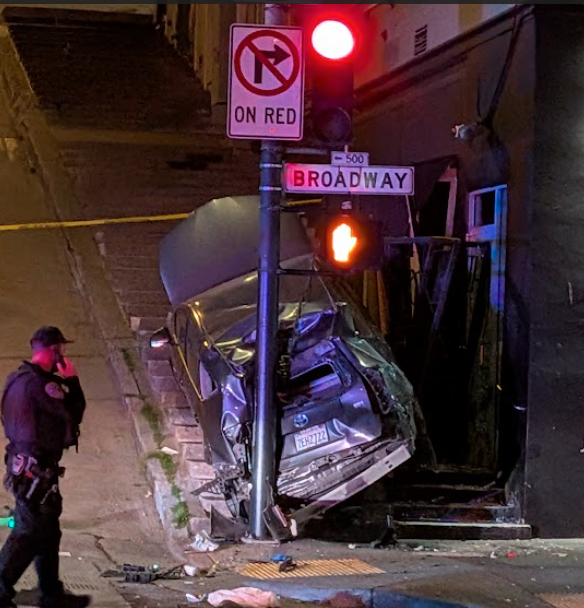
Motorist Careens onto North Beach Sidewalk, Killing Pedestrian
Driver kills pedestrian at another location where a safety project festered
The post Motorist Careens onto North Beach Sidewalk, Killing Pedestrian appeared first on Streetsblog San Francisco.