What’s the Best Way to Make Biking Mainstream in a Car-Centric City?

How can you turn a car-dependent city into a place where most people feel safe cycling for transportation?
Researchers in Auckland, New Zealand, created a predictive model to assess how different policies affect cycling rates over several years. In a paper published in the journal Environmental Health Perspectives [PDF], they concluded that a combination of protected bike lanes on all wide arterial roads plus traffic calming measures on neighborhood side streets would have a far greater impact on bike mode share than Auckland’s current bike plan.
Only 19 percent of Auckland residents say they currently consider cycling to be “always or mostly safe.” The city’s bike commute mode share stands at 2 percent. While the region has set out to achieve a 35 percent combined biking and walking mode share by 2040 (the walk commute rate is currently 5.5 percent), its actual policies are not that ambitious. The Auckland bike plan calls mainly for un-protected lanes and off-street paths.
Using prior studies, travel surveys, interviews, and historical data, the researchers created a model designed to factor in the complex interactions between bicycling rates and traffic speeds, motor vehicle volumes, street design, the number of cyclists on the road, the number of actual injuries, and subjective perceptions of safety.
Then they plugged four different policy scenarios into their model: the current Auckland bike plan; redesigning residential streets for slow speeds; adding protected bike lanes on all arterial streets; and combining residential traffic calming with bike lanes on arterials. Only the combination scenario had the power to achieve Auckland’s bicycling goals, according to the model.
While there is some uncertainty inherent in a model like this, the researchers found that “realistic changes to policy assumptions did not change the shape of outcome behaviors over time.”
Researchers also analyzed how growth in cycling can improve public health, decrease air pollution-related mortality, reduce cycling-related injuries, and decrease greenhouse gas emissions, among other outcomes. They found that the combination approach of protected bike lanes and neighborhood traffic calming would also be the most cost effective, with benefits that outstrip the costs by a factor of 24. The biggest benefit, according to the model, would be the lower rate of premature death caused by inactivity.

Streetsblog has migrated to a new comment system. New commenters can register directly in the comments section of any article. Returning commenters: your previous comments and display name have been preserved, but you'll need to reclaim your account by clicking "Forgot your password?" on the sign-in form, entering your email, and following the verification link to set a new password — this is required because passwords could not be carried over during the migration. For questions, contact tips@streetsblog.org.
More from Streetsblog USA
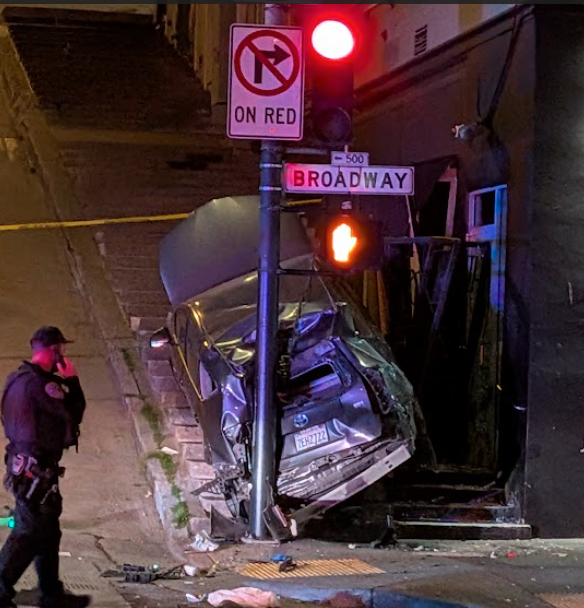
Motorist Careens onto North Beach Sidewalk, Killing Pedestrian
Driver kills pedestrian at another location where a safety project festered
The post Motorist Careens onto North Beach Sidewalk, Killing Pedestrian appeared first on Streetsblog San Francisco.