HUD Expected to Loosen Restrictions on Mixed-Use Financing Soon

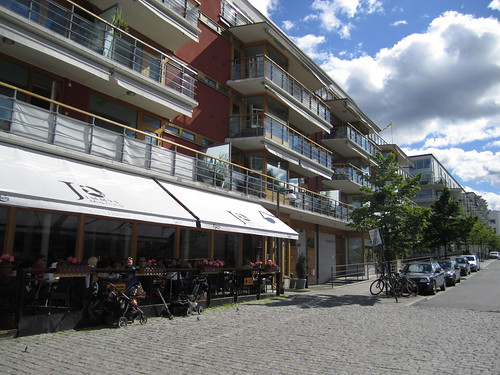
As Smart Growth America showed us earlier today, the costs of sprawl are high. So it’s a bitter irony that federal rules have made it more expensive to build compact, mixed-use development by tightly limiting the share of commercial space in projects that receive financing from the Department of Housing and Urban Development.
Fortunately, those rules have started to loosen in recent years, and today on the Streetsblog Network, Rob Steuteville at Better Cities and Towns reports that HUD is expected to make more progress on this front:
The financing of low-to-mid-rise mixed-use buildings, restricted by federal rules since the 1930s, will likely become easier this year, the Congress for the New Urbanism (CNU) reports.
The Federal Housing Authority (FHA) raised its nonresidential loan limits to 35 percent from 20 percent in 2012 — now it looks like the US Department of Housing and Urban Development (HUD) is moving forward with reforms in other programs.
Officials from HUD’s multifamily unit recently told CNU president and CEO John Norquist, New York Regional Plan Association executive director Thomas Wright and Richard Oram of the Oram Foundation that further reforms are expected in HUD’s Sections 221d4 and 220 multifamily financing programs, due for release in September 2014.
“What is likely to happen is that HUD 220 and 221d4 caps will be raised up to 35 percent,” Norquist says. “This could vary by project characteristics and location, but allowing up to 35 percent non residential is a big deal.” The higher FHA mortgage nonresidential caps have worked, Norquist says.
Old mixed-use restrictions remain in place at mortgage giants Fannie Mae and Freddie Mac, however. Reforming Fannie and Freddie is tougher than adjusting internal rules at HUD, says Norquist:
“Fannie and Freddie are harder to change. Their leadership has been in flux and Congress has been considering legislation to either abolish or radically change” these organizations. “It is easier to deal with FHA and HUD because they can make the changes we seek without having to go thru Congress to change federal law.”
Elsewhere on the Network today: Cyclelicious makes a pretty good argument that yesterday’s “vehicular pedestrian” gag might contain a kernel of truth. Walkable Dallas Fort Worth explains why devoting transportation resources to curing congestion is a bad investment. And Bike Pittsburgh relays the news that Mayor Bill Peduto is moving ahead with the city’s first downtown protected bike lane.

Read More:
Streetsblog has migrated to a new comment system. New commenters can register directly in the comments section of any article. Returning commenters: your previous comments and display name have been preserved, but you'll need to reclaim your account by clicking "Forgot your password?" on the sign-in form, entering your email, and following the verification link to set a new password — this is required because passwords could not be carried over during the migration. For questions, contact tips@streetsblog.org.
More from Streetsblog USA
Motorist Careens onto North Beach Sidewalk, Killing Pedestrian
Driver kills pedestrian at another location where a safety project festered
The post Motorist Careens onto North Beach Sidewalk, Killing Pedestrian appeared first on Streetsblog San Francisco.