Lowering Parking Minimums Is Nowhere Close to a "War on Cars"
The famed “War on Cars” — who among us hasn’t heard this tired hyperbole tossed around with wild abandon? Want to install a bike lane? Gasp! “War on cars!” Speeding cameras in school zones? “War on cars!!” Raise tolls to cover the huge cost of roads? “WAR ON CARS!!!”

You know how it goes. Paul Barter at Reinventing Parking was reflecting on this rhetoric recently after a proposal to ease parking minimums in Santa Monica elicited the predictable response. Barter says calling policies like these a “war on cars” is akin to saying women’s early struggles for voting rights were “anti-men” because “it involves ignoring a huge edifice of policies that are actually skewed in the other direction.”
Slightly easing a policy that FORCES excessive parking into the landscape is a far cry from actually restraining car use or ownership. Please get this straight. Today’s conventional parking policies are not mode neutral.
They are not agnostic about people’s mobility choices. They are not a natural expression of individuals’ preferences about our transport systems or our towns and cities.
In fact, the American-style conventional parking policies that have spread around the world are just about as far from mode neutral as they could possibly be. These policies don’t just acquiesce to people’s car preferences. They shape those preferences. They effectively pull people into cars and reshape the landscape to keep them there.
The process of setting parking requirements makes arbitrary but self-fulfilling prophecies about how many people will own and use cars in every single building far into the future The process often even aims to make enough room for the busiest time of the busiest day of the year. The procedure generally assumes that all this parking will be free-of-charge to the motorists.
This prompts parking to be bundled with all other real estate, effectively forcing private actors (including you and me) to cross-subsidise car ownership and car use. So most new developments being built around the world continue to include much more parking than we need or than the actual users would willingly pay for.
Speaking of the “war on cars,” elsewhere on the Network today, West North reports that, in response to a plan that will reduce parking 0.2 percent in D.C.’s Downtown and Golden Triangle areas, the local AAA complained that “the bike lanes have taken up all the parking spaces.” Bike Denver explains the impressive strides the Mile High City has made in its commitment to become a multi-modal city. And Stop and Move wonders what Fresno could learn from Oklahoma City.

Read More:
Streetsblog has migrated to a new comment system. New commenters can register directly in the comments section of any article. Returning commenters: your previous comments and display name have been preserved, but you'll need to reclaim your account by clicking "Forgot your password?" on the sign-in form, entering your email, and following the verification link to set a new password — this is required because passwords could not be carried over during the migration. For questions, contact tips@streetsblog.org.
More from Streetsblog USA
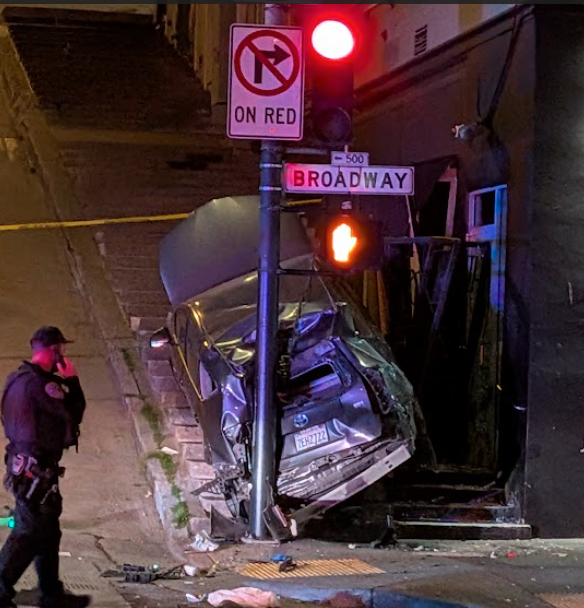
Motorist Careens onto North Beach Sidewalk, Killing Pedestrian
Driver kills pedestrian at another location where a safety project festered
The post Motorist Careens onto North Beach Sidewalk, Killing Pedestrian appeared first on Streetsblog San Francisco.