Nothing to Fear But Drivers’ Lack of Fear

Recently, I shared with a car enthusiast friend that I would never enjoy driving as much as he did, in part because cars scared me a little. I had experienced crashes and lost loved ones to them, I explained, which had a lasting effect. This struck him as both silly (who’s afraid of cars?) and serious (what’s life without the joy of driving?). He had an easy solution, though: Take an advanced driving skills class. My fear, if warranted, would be swept away by my improved ability or, if unwarranted, by my newfound confidence.
I balked at the suggestion. Surely, better drivers’ education would make roads less dangerous, and someone with a genuine phobia of cars might suffer in our auto-centric world. But we’d also all be a good deal safer if more drivers held a bit more fear.
Despite advances in traffic and car safety, driving remains the most perilous thing most of us do each day. And though the average American is more likely to be killed with a car than with a gun, on the whole, drivers have little anxiety about driving. Hubris is just one of several reasons why. The propensity of drivers to overestimate their ability has been well documented, especially by Tom Vanderbilt. In Traffic, he explains how the false sense of control and ease driving provides, along with humans’ inability to self-assess, allows most drivers to rate themselves “above average.” The dangerous outcome is a “narcissism” that encourages aggressive driving.
“Do the thing we fear, and the death of fear is certain,” Emerson wrote. Do the thing several times a day, and it becomes banal. Though how much and how fast we drive are key determinants of crash risk, driving everywhere, no matter how short the trip, and speeding, no matter how little time is saved, have been normalized. This normalization is what makes crashes, when they happen, so difficult to process. One grief counselor described how a client, struggling to grasp his brother’s death in a crash, sat in her office “week after week saying, ‘He just went to get milk.’”
There are other reasons why we view our chances of crashing as remote. Scant media coverage of crashes, unless somehow anomalous and spectacular — a plane landing on a New Jersey highway, killing five, a nineteen-vehicle pile-up in Florida — helps encourage our sense of invulnerability. The efficiency of modern crash response makes everyday disasters less visible and reduces rubbernecking, which can snarl traffic and be dangerous but serves a purpose. Seeing is believing.
But who wants to see it? Who wants to dwell on the dangers, when there seems little choice but to drive to get to shops, to work, to school? The companies who sell us cars and insurance understand this well. A few use fear to sell coverage. (Allstate’s black-humored “Mayhem” campaign, for example, catalogs the threats posed by other vehicles, pedestrians, animals, acts of God — reinforcing fear of everything but our own behavior.) Most insurers instead facilitate our denial. In Liberty Mutual ads, F/X magic returns crushed and crumpled cars to pristine newness, intimating that the right insurance makes “accidents” go away. Nationwide uses hilarity to chase away fear; its current commercial shows a rollover as downright hysterical! Not one drop of coffee — or blood — is spilled.
The cars on the market today offer more safety equipment than ever; advances such as blind spot and pedestrian detection systems are added each model year. While this is reason to celebrate, a car with these technologies can also make its owner feel free to drive more recklessly. Wider public perception of safety is also inflated by the automakers’ relentless advertising around these innovations, despite, as the Highway Loss Data Institute recently demonstrated, that they can take three decades to make their way across the national fleet.
Other automotive engineering efforts would seem to work against safety improvements, even setting aside — and it’s a big set-aside — distracting infotainment technologies. The car companies toil to make vehicle interiors as quiet and road conditions as unintrusive as possible. Their overriding goal: have drivers feel safe, feel in control. With excessive speed a major contributor to crashes, however, it might be better to feel potholes and thus drive more slowly, to sense our speed and take turns more cautiously.
A telling experience came for me at General Motors’ Milford Proving Grounds a few years ago. During a test drive for journalists, my turn came to try out a new crossover on a wet-slick course. I was supposed to initiate a skid, so that the automatic stability control would kick in and help right the vehicle. But I drove too slowly—I was too nervous—and the vehicle didn’t skid. The second time, I sped up, skidded, and the ASC kicked in, proving that it was a potential lifesaver. But so was my fear.
Anne Lutz Fernandez, a former investment banker and marketing executive, is co-author, with anthropologist Catherine Lutz, of Carjacked: The Culture of the Automobile and its Effect on Our Lives.

Read More:
Streetsblog has migrated to a new comment system. New commenters can register directly in the comments section of any article. Returning commenters: your previous comments and display name have been preserved, but you'll need to reclaim your account by clicking "Forgot your password?" on the sign-in form, entering your email, and following the verification link to set a new password — this is required because passwords could not be carried over during the migration. For questions, contact tips@streetsblog.org.
More from Streetsblog USA
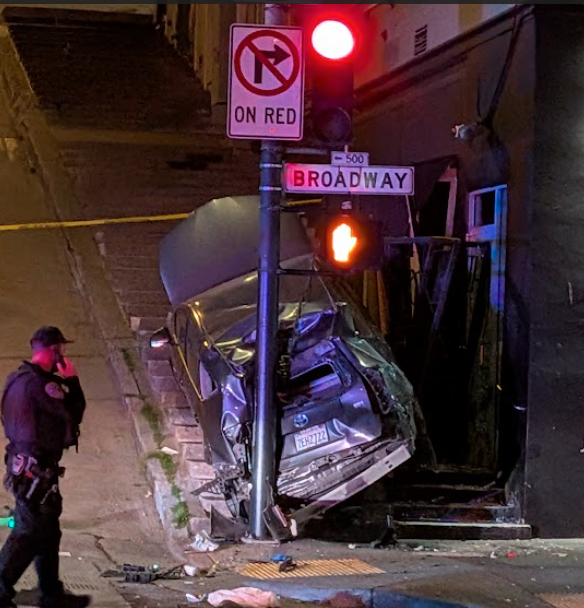
Motorist Careens onto North Beach Sidewalk, Killing Pedestrian
Driver kills pedestrian at another location where a safety project festered
The post Motorist Careens onto North Beach Sidewalk, Killing Pedestrian appeared first on Streetsblog San Francisco.