CRS: Northeast Corridor Privatization Plan Violates Constitution

The nonpartisan Congressional Research Service has examined the question of whether the GOP plan to privatize Amtrak’s most valuable corridor is constitutional – and it’s determined that it is not.

Warning: this is about to get a little wonky. But I figure if Streetsblog readers can get all nerdy on transit, you can probably geek out on legalese every once in a while too.
CRS looked at two constitutional provisions and found that the GOP plan violates them both.
First: the Takings Clause [PDF]. The government is allowed to take private property for public use, as long as the owner is justly compensated. The bill proposes to transfer the corridor and rolling stock from Amtrak to the USDOT.
According to CRS, this poses three constitutional questions:
- Is Amtrak an entity outside the government? (It’s not a “taking” if property is transferred to different agencies within the government.) On this question, CRS says that the federal statute creating Amtrak unequivocally stated that it “is not a department, agency, or instrumentality of the United States Government.” The courts have upheld this definition.
- Do the assets to be transferred constitute “property” under the Takings Clause? CRS says they are “classic, well-established forms of Taking Clause property.”
- Is the transfer of assets from Amtrak to USDOT a taking? Indeed, it’s a “paradigmatic” taking, according to CRS. The only way for the term not to apply is if the transfer were somehow deemed non-coercive, since the draft bill contains no mechanism for enforcement. Still, CRS concludes that the “not-truly-coercive argument seems unlikely to succeed.”
OK, so it’s a taking. That’s fine – as we said, the constitution allows takings – as long as they’re justly compensated and for the public use. Whatever you think of the plan to privatize Amtrak, apparently just about anything Congress decides to do satisfies the “public use” clause. But the question of compensation is thornier.
Under the bill, the compensation Amtrak will be awarded consists of “all but one share of the preferred stock of Amtrak held by the Secretary” (USDOT holds all of Amtrak’s preferred stock) and relief of all debts to USDOT. CRS doesn’t make a determination on what the value of that compensation is, but Amtrak’s common stock, at least, is virtually worthless.
Either way, CRS says, it’s not so much the amount of the compensation as its form that is troubling. State courts have consistently found that “money is the only legally adequate compensation.”
Moving on now to the Appointments Clause [PDF]. Paradoxically, the reasoning behind CRS’s conclusion that the rail plan violates the Appointments Clause contradicts the reasoning behind its conclusion that it violates the Takings Clause.
The Appointments Clause protects the separation and balance of powers by vesting the president with the power to appoint high-level officials only with the advice and consent of the Senate. The rail privatization proposal would create a Northeast Corridor Committee that essentially takes over the powers of Amtrak, with broad authority over the acquisition and improvement of rail facilities. CRS finds that the powers given to the members of that committee are significant enough to warrant presidential appointment with Senate approval, under the Appointments Clause.
Here’s the rub: in order to determine this, CRS found that Amtrak is enough of a federal entity to warrant constitutional appointments, as to any other key federal post. In so doing, it cites a Supreme Court case that decided that Amtrak was enough of a federal entity that it had to abide by governmental free-speech mandates.
In discussing the Takings Clause, CRS found this case to be somewhat of an outlier in a case history that generally defined Amtrak as independent. But in discussing the Appointments Clause, CRS quotes the Justice Department as saying “we can conceive of no principled basis for distinguishing between the status of a federal entity vis-à-vis constitutional obligations relating to individual rights and vis-à-vis the structural obligations that the Constitution imposes on federal entities.” Which is to say, either Amtrak is a federal entity or it isn’t. And in this case, they found that it is.
The way that the House had proposed to appoint the five members of the executive committee was a little more haphazard than what the Appointments Clause mandates. The committee, under the plan, would consist of (A) The Secretary of Transportation, (B) one member representing the states of the Northeast Corridor, appointed by the governors (and DC’s mayor), (C) one member appointed by the Speaker of the House of Representatives and one member appointed by the majority leader of the Senate, and (D) one member, selected by a majority of the voting members of the Northeast Corridor Infrastructure and Operations Advisory Commission.
The House Transportation Committee can try to argue with the contradictions behind the CRS results, but it most likely cannot escape the fact that the rail plan, as currently written, violates at least one constitutional amendment.
Top committee Democrat Nick Rahall of West Virginia couldn’t be more pleased. “The ideals enshrined in the Constitution by our Founding Fathers have guided our Nation for centuries and Republicans should not railroad these principles in their flawed rush to privatize Amtrak,” he said in a statement. “This ideological assault on Amtrak is nothing more than a Transcontinental Tragedy that will result in a Constitutional Catastrophe.”

Read More:
Streetsblog has migrated to a new comment system. New commenters can register directly in the comments section of any article. Returning commenters: your previous comments and display name have been preserved, but you'll need to reclaim your account by clicking "Forgot your password?" on the sign-in form, entering your email, and following the verification link to set a new password — this is required because passwords could not be carried over during the migration. For questions, contact tips@streetsblog.org.
More from Streetsblog USA
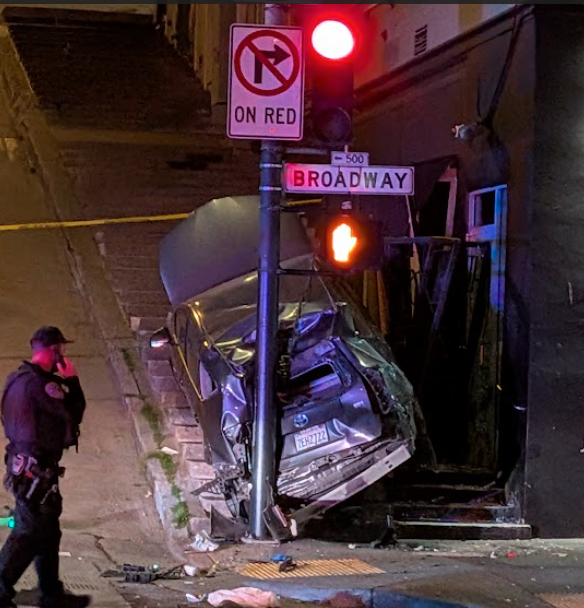
Motorist Careens onto North Beach Sidewalk, Killing Pedestrian
Driver kills pedestrian at another location where a safety project festered
The post Motorist Careens onto North Beach Sidewalk, Killing Pedestrian appeared first on Streetsblog San Francisco.