Cul-de-Sacs Are Killing Us: Public Safety Lessons From Suburbia

People choose suburban neighborhoods over urban ones for myriad reasons: because they can afford it, because the schools are good, because it’s a quiet street, or crimes rates are low, or everyone walks around with baby strollers and golden retrievers, or their family is nearby. But countless other consequences stream from their decision of where to live.

If people can’t or don’t walk or bike where they need to go, they’ve also bought themselves carbon emissions from excessive driving. Hours lost in traffic congestion. Growing waistlines from spending time behind a wheel instead of on two wheels, or two feet. Stress and relationship problems. And even worse: The suburb they chose “because it’s safe” ends up being far more dangerous than the city they fled.
William Lucy, a professor at the University of Virginia and former chair of the Charlottesville Planning Commission, says that people’s decision making about where to live has such sweeping ramifications that he’s concentrated his professional work on it. And it’s why he focuses on danger and death: specifically, the danger of leaving home.
At a daylong forum yesterday on intelligent cities at the National Building Museum, Lucy could barely wait to lay into cul-de-sacs, which he says were designed for safety but end up being more dangerous than through-streets.
“They turn what should be a 100-yard walk into a two-mile drive, and they put more people in cars for more reasons than they should,” Lucy said. And because they get lulled into a sense of security, he said, parents don’t teach their kids about street safety and the “difference between street and sidewalk and driveway and yard.”
But the greatest danger to a young child, he said, is being backed over by a motor vehicle – usually driven by their own parents in their own driveway. Indeed, “backovers” account for 34 percent of “non-traffic” vehicular fatalities among children under 15 years old. (“Frontovers” account for another 30 percent, meaning that 64 percent of “non-traffic” vehicular fatalities still involve children being run over, according to KidsAndCars.org.)
Because these incidents occur on private property, they’re not considered “traffic” accidents and data is not collected by national traffic safety organizations. Meanwhile, Lucy said, squeamishness over openly reporting on the tragedy of a parent killing his or her own child with a car leads newspapers to bury news of backovers – missing a “teachable moment.”
Back to the “danger of leaving home”: Lucy compares the rates of homicides by strangers and traffic fatalities. (He studies homicides by strangers because he focuses on the danger of leaving the home: 80 percent of homicides are committed by someone the victim knew.) When people choose “safe” neighborhoods, they are often trying to protect their children (and themselves) from crime. But he finds that the likelihood of dying in a traffic accident is 13 times greater than the likelihood of being killed by a stranger. The most dangerous places, therefore, are those thought to be the safest, Lucy said: the outer suburbs.
He also stressed that “more crashes” doesn’t mean “more danger.” In urban areas, where cars are going slower, there are more crashes — but lots of them are fender-benders that don’t result in injury. Indeed, Lucy said, you’ll find less danger where there are more crashes. But where cars are traveling at high speeds, crashes are far more serious – both for people in cars and people biking or walking along the road.
“Young parents are choosing a location based on schools, but unfortunately, there are not enough parents of young children who are sufficiently aware that young children grow up to be teenagers,” Lucy said. “Nothing is more dangerous than a teenager in a car on a two-lane road at midnight after having had a little too much to drink.”
Perceptions of safety can sabotage actual safety in other surprising ways. Lucy likes to say that it’s the fire department that plans a city. Fire departments argue for wide intersections with gradual corners, even onto tiny cul-de-sac streets, making pedestrian crossings longer and more dangerous. Or the fire department mandates so many expensive fire-code fixes as old buildings get retrofitted for new uses that the project becomes too expensive. And then the outcome is a vacant building, which is far less safe than an occupied one.

Read More:
Streetsblog has migrated to a new comment system. New commenters can register directly in the comments section of any article. Returning commenters: your previous comments and display name have been preserved, but you'll need to reclaim your account by clicking "Forgot your password?" on the sign-in form, entering your email, and following the verification link to set a new password — this is required because passwords could not be carried over during the migration. For questions, contact tips@streetsblog.org.
More from Streetsblog USA
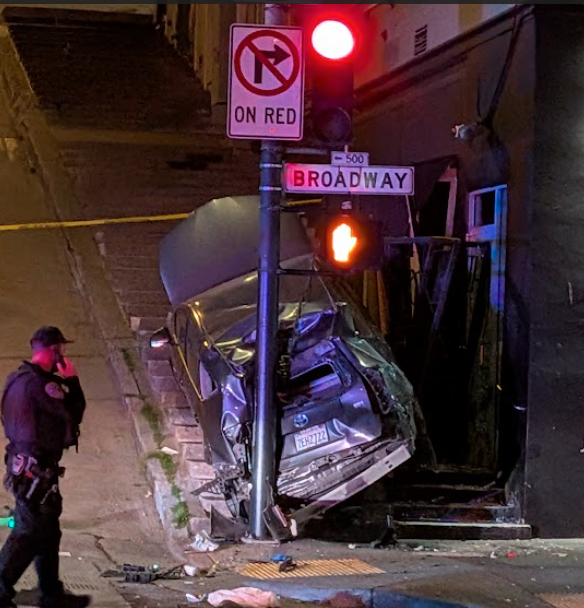
Motorist Careens onto North Beach Sidewalk, Killing Pedestrian
Driver kills pedestrian at another location where a safety project festered
The post Motorist Careens onto North Beach Sidewalk, Killing Pedestrian appeared first on Streetsblog San Francisco.