SGA: Transportation Funding Pays Big Dividends Only If Invested Wisely

In just the last month, several reports have quantified, in various ways, how investing in transportation infrastructure pays off in jobs and economic health. Now Smart Growth America is out with new research showing that it’s not enough to plunk down a bunch of money and expect miracles. You’ve got to do it right.

Doing it right, SGA says, consists of the following recipe:
- Preserve existing roads and bridges
- Build public transportation
In its report, “Recent Lessons from the Stimulus: Transportation Funding and Job Creation,” released Friday, SGA found that on average, road repair produced 16 percent more jobs per dollar than new road construction. And public transportation beat that handily, creating 31 percent more jobs per dollar than new road construction.
SGA also suggests building connections between existing transportation hubs and regional centers. And it says that focusing on areas hard hit by unemployment will create a bigger bang for your buck.
Looking at how different states invested the $26.6 billion in stimulus money for transportation, SGA picked some winners and losers in the game to use stimulus dollars most effectively:
- Connecticut, the District of Columbia, Maine, New Jersey, North Dakota, Rhode Island, South Dakota, and Vermont used 100 percent of their stimulus allocations for roads on repair and maintenance, rather than new capacity.
- Texas, Kentucky, Florida, Arkansas, and Kansas went for new capacity instead of maintenance.
- D.C., Oregon, Massachusetts, and New York dedicated more than 20 percent of the funds to public transit.
- Nebraska, Louisiana, Wyoming, Nevada, and Arkansas gave the least.
SGA found that every billion dollars spent on road capacity resulted in 2.4 million work-hours, while every billion spent on transit resulted in 4.2 million work-hours.
Recommendations to states, Congress, and the U.S. DOT suggest that in order to fight unemployment and lay the foundation for long-term economic growth, they should reconsider their preference for road-building when investing future infrastructure dollars.
Overall, of the $26.6 billion the stimulus invested in transportation, 58.9 percent went to road preservation projects. One-third went to new road capacity. Less than four percent went to non-motorized projects like pedestrian and bike facilities or streetscape improvements. And just 1.7 percent went to public transportation.

Read More:
Streetsblog has migrated to a new comment system. New commenters can register directly in the comments section of any article. Returning commenters: your previous comments and display name have been preserved, but you'll need to reclaim your account by clicking "Forgot your password?" on the sign-in form, entering your email, and following the verification link to set a new password — this is required because passwords could not be carried over during the migration. For questions, contact tips@streetsblog.org.
More from Streetsblog USA
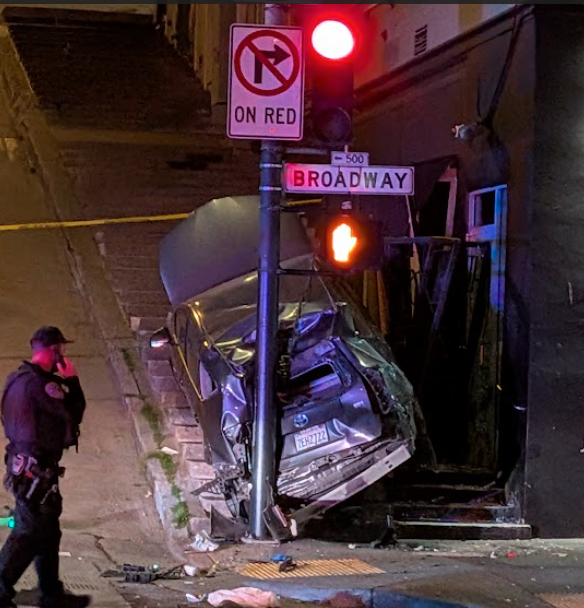
Motorist Careens onto North Beach Sidewalk, Killing Pedestrian
Driver kills pedestrian at another location where a safety project festered
The post Motorist Careens onto North Beach Sidewalk, Killing Pedestrian appeared first on Streetsblog San Francisco.