

The Transit Hierarchy of Needs


 Chevrolet appeals to one of the most basic levels of need — safety — while insulting transit riders everywhere. Image via Dead Horse Times
When I find myself complaining about city subway or bus service — while waiting too long for the bus or watching helplessly from one train as the one I need to transfer to leaves the station — I try to keep in mind that, maybe above all else, the relative ease of car-free mobility is the reason I live in New York. Jarrett Walker of Human Transit might say that, by having the choice to make my home in such a place, I have reached the self-actualization level on the Transit Hierarchy of Needs.
Drawing on a post from The Dead Horse Times, Walker explains that by applying Abraham Maslow’s Hierarchy of Needs to public transportation, advocates might come to a better understanding of “what’s really important” when it comes to growing transit ridership while meeting the needs of those for whom transit is mostly a means to the most basic ends.
We transport planners are sometimes cast as narrow-minded because we obsess about travel time. But we obsess about it because human beings do. When an urbanist such as Patrick Condon suggests that I should want transit to be slower so that it will foster better communities, I sense a problem that Maslow’s pyramid might elucidate.
Where in Maslow’s pyramid would we locate our need for speed? You might argue that it depends on the purpose of travel, but the vast majority of our travel is about the three lowest levels of the pyramid. These levels — Physiological, Safety and Love/belonging — are what motivate us to work, and work is one of the great drivers of transit demand.
More directly, the anxious basic lower-level needs are why we often feel “we just need to get there.” You’re waiting for a bus or train because you want to be home where it’s safe (Safety). Or you want to get home to your partner or child (Safety and Love/belonging). Or you’re hungry — a Physiological need.
When we engage in conversations about what makes a great city, or for that matter a good life, we have to remember that outside the sealed windows of our salon or charrette or network of likeminded blogs, most of our fellow citizens are working on more fundamental needs, and are motivated by those needs as they travel in the city. They’re buying food, or earning their rent money, or getting home to their families.
In a somewhat related post, Second Avenue Sagas fears that New York’s “new” digital subway signage is already 10 years behind. Also on the Network today: Twin City Sidewalks on how Sesame Street is a bad model for public space; DC Bike Examiner on instances when transit isn’t “green”; and Soap Box LA on the new era of cooperation between cyclists and LAPD.

Read More:
Support Streetsblog
More from Streetsblog USA
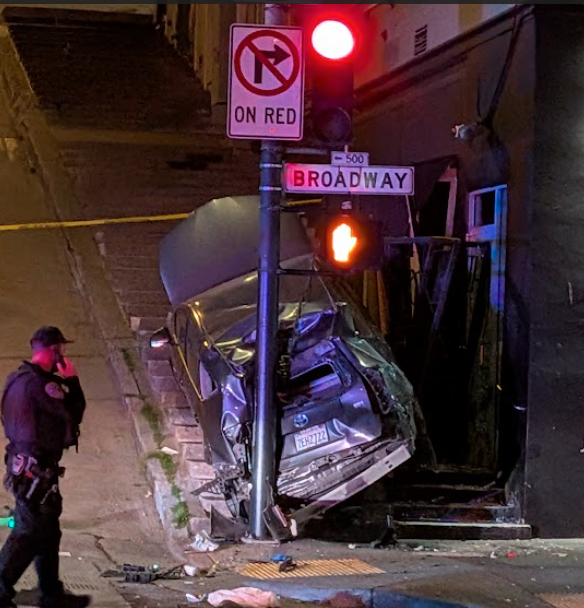
Motorist Careens onto North Beach Sidewalk, Killing Pedestrian
Driver kills pedestrian at another location where a safety project festered
The post Motorist Careens onto North Beach Sidewalk, Killing Pedestrian appeared first on Streetsblog San Francisco.




Comments Are Temporarily Disabled
Streetsblog is in the process of migrating our commenting system. During this transition, commenting is temporarily unavailable.
Once the migration is complete, you will be able to log back in and will have full access to your comment history. We appreciate your patience and look forward to having you back in the conversation soon.