Report: White House Budget Office Helped Weaken EPA Pollution Rule

Pensacola, Florida. Springfield, Missouri. Fort Wayne, Indiana. All three of those metropolitan areas have populations between 350,000 and 500,000, and all three would have been required to install nitrogen dioxide monitoring stations near major roadways under a new Environmental Protection Agency (EPA) rule cracking down on the pollutant.
 Cass Sunstein, chief of the White House budget office’s regulatory arm. (Photo: Wonk Room)
But as the Center for Progressive Reform (CPR) noted soon after the EPA unveiled its rule, an initial draft setting the minimum population for local air-quality monitoring at 350,000 was changed to 500,000, leaving out cities such as Fort Wayne and effectively weakening the nitrogen dioxide rule’s accountability.
Another watchdog group traced the change to the White House Office of Management and Budget, which evaluates new agency regulations through a smaller arm called OIRA (short for the Office of Information and Regulatory Affairs). The president’s nominee to lead OIRA, Cass Sunstein, has taken heat from green groups for his past criticism of government’s role in the rule-making process.
What’s the significance of the OMB’s change to the EPA rule? “The fewer the monitors, the more likely it is that many metropolitan
areas will be able to exceed EPA’s limits without detection or
correction,” CPR president and law professor Rena Steinzor wrote on the group’s blog in late January.
Steinzor’s post also addressed the significance of the new nitrogen dioxide rule, noting that the pollutant tends to be especially common, and dangerous, in lower-income neighborhoods located near busy roads:
Scientific evidence links human NO2 exposure with various respiratory health problems. … The biggest source of NO2 pollution is automobile emissions, though
power plants and heavy industry are also significant contributors. NO2
pollution levels tend to be greater in urban areas and near major
roadways, which means NO2 pollution tends to disproportionately harm
the poor and communities of color.
(h/t Wonk Room)

Streetsblog has migrated to a new comment system. New commenters can register directly in the comments section of any article. Returning commenters: your previous comments and display name have been preserved, but you'll need to reclaim your account by clicking "Forgot your password?" on the sign-in form, entering your email, and following the verification link to set a new password — this is required because passwords could not be carried over during the migration. For questions, contact tips@streetsblog.org.
More from Streetsblog USA
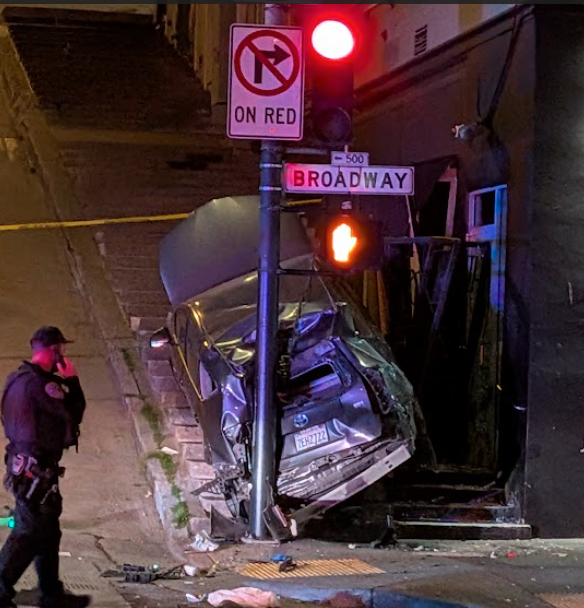
Motorist Careens onto North Beach Sidewalk, Killing Pedestrian
Driver kills pedestrian at another location where a safety project festered
The post Motorist Careens onto North Beach Sidewalk, Killing Pedestrian appeared first on Streetsblog San Francisco.