Brasilia’s Pathways of Desire
Sometimes you just can’t stop human beings from acting like animals. And I mean that in the best possible way.
Take, for example, the walking paths of Brasilia, the Brazilian capital city that was planned down to the smallest detail in the 1950s and ’60s — planned for a populace that would move about exclusively by automobile.

But as you can see from the photo posted by Daniel Nairn of Discovering Urbanism this weekend, the people of Brasilia still move about by foot, leaving their mark in the grassy areas between mega-freeways:
These
rogue pedestrians don’t have an easy task. Virtually the only way to
access this space is to cross at least six lanes of traffic and then
cross another six lanes to exit. The width of the open space is 1/4 of
a mile, which is exactly twice the width of the national mall in
Washington D.C., and there is no shade or amenities whatsoever. They
still make the journey.…This
is the network of function over geometry. The paths are trodden out of
convenience, but they also gently meander. Lewis Mumford recognized this universal tendency back in 1961, just as Brasilia was under construction: “The
slow curve is the natural line of the footwalker, as anyone can observe
as he looks back at his tracks in the snow across an open field.”Although
it’s hard to prove conclusively, it looks like safety concerns played a
part in determining where the highways were crossed. Several paths seem
to converge at points where on-ramps and off-ramps are separated from
the main flow of traffic. Crossing at these points allows the
pedestrian to have breaks of median before having to make the next
step. It looks as if some people have been willing to sacrifice a
certain degree of time in order to cross a little more safely at one of
these points.Interestingly, these points of convergence are
analogous to the forces that led to the origins of medieval Paris.
For more about the what French philosopher Gaston Bachelard called “chemins du désir,” or “pathways of desire,” see the excellent post on Detroit’s emerging web of walking paths on Sweet Juniper! It’s one of the best blogs being written today from the urban frontier.
More from the network: Reports of assaults by drivers on cyclists from Tulsa Alternative Transportation Examiner and Transit Miami. Also, Human Transit on the breaking of London’s Circle Line, and Hub and Spokes on Mexico City’s BRT plans.

Read More:
Streetsblog has migrated to a new comment system. New commenters can register directly in the comments section of any article. Returning commenters: your previous comments and display name have been preserved, but you'll need to reclaim your account by clicking "Forgot your password?" on the sign-in form, entering your email, and following the verification link to set a new password — this is required because passwords could not be carried over during the migration. For questions, contact tips@streetsblog.org.
More from Streetsblog USA
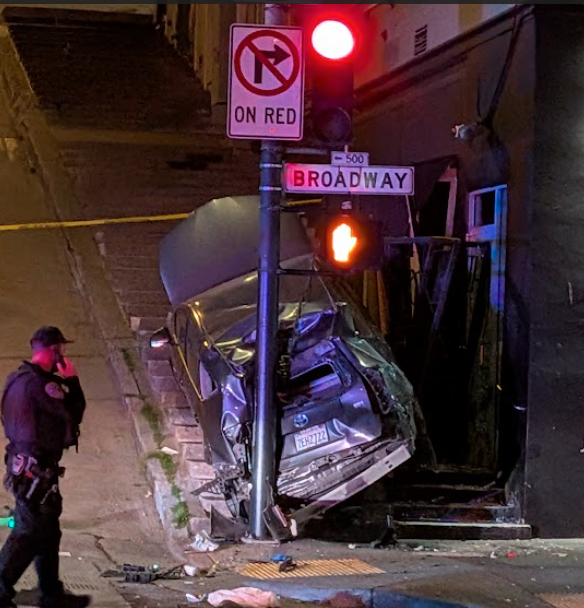
Motorist Careens onto North Beach Sidewalk, Killing Pedestrian
Driver kills pedestrian at another location where a safety project festered
The post Motorist Careens onto North Beach Sidewalk, Killing Pedestrian appeared first on Streetsblog San Francisco.