

Audit Finds U.S. DOT’s Transit Record-Keeping ‘Unreliable,’ ‘Inaccurate’


The disjointed state of “New Starts,” the Federal Transit Administration’s (FTA) program to fund new rail and bus lines, is well-known on the Hill — in fact, House transportation committee chairman Jim Oberstar (D-MN) recently quipped that it ought to be renamed “small starts, low starts, and no starts.”
 Thousands gathered to board the new light rail line in Charlotte in 2007. (Photo: Light Rail Now)
With Oberstar’s six-year transportation re-write bill in limbo for the moment, however, there appears to be scant political urgency to fix the program. But a report released today by the non-partisan Government Accountability Office (GAO) could help change that picture.
It can take as long as 14 years for transit planners to secure a full-funding New Starts grant agreement (FFGA), the final stage required before starting construction.
Yet when GAO auditors set out to break the process down by its stages (which are depicted in a comically complex chart after the jump) they found the FTA could only provide complete information for 9 out of 40 New Starts projects approved since 1997.
“We were unable to obtain complete and reliable project milestone data from FTA,” GAO auditors wrote. An attempt to confirm records for a random sample of 10 New Starts projects found the information to be “unreliable and, in some cases, inaccurate.”
The GAO report then outlined the FTA’s explanation for its inconsistent data:
First, FTA told us that it does not have records on when a project begins alternatives analysis because this phase is conducted at the local level, generally without FTA involvement. Second, FTA told us that it does not record when a project sponsor submits an application for preliminary engineering, final design, and FFGA because project sponsors almost never submit complete applications.
The bureaucratic hurdles that transit planners must clear to win federal aid stand in stark contrast to road projects’ usually unobstructed path to approval. But without solid data to make the case for fixing New Starts, transit advocates’ already arduous political fight for fairer treatment is likely to get even harder.
The GAO report can be downloaded in full here.
 (Photo: GAO)
Read More:

Support Streetsblog
More from Streetsblog USA
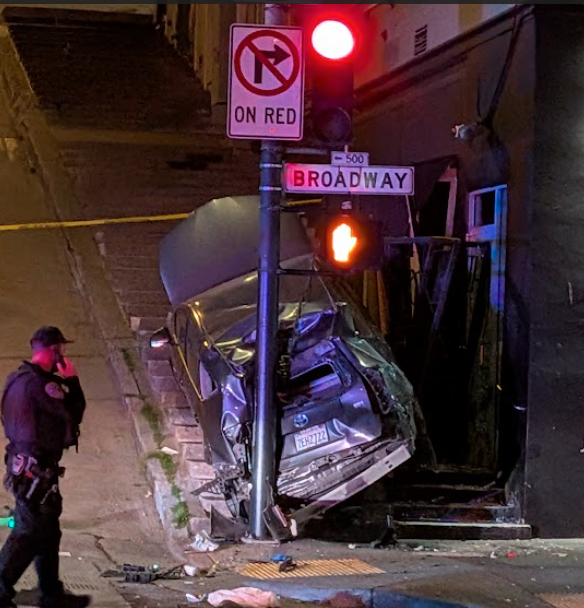
Motorist Careens onto North Beach Sidewalk, Killing Pedestrian
Driver kills pedestrian at another location where a safety project festered
The post Motorist Careens onto North Beach Sidewalk, Killing Pedestrian appeared first on Streetsblog San Francisco.







Comments Are Temporarily Disabled
Streetsblog is in the process of migrating our commenting system. During this transition, commenting is temporarily unavailable.
Once the migration is complete, you will be able to log back in and will have full access to your comment history. We appreciate your patience and look forward to having you back in the conversation soon.