

House Climate Bill on Green Transpo: The Details


Late Update: An earlier version of this post used the committee-approved version of
the climate bill rather than the final, House-passed version. The climate bill’s identifying number was changed at the last minute, from the original H.R. 2454 to H.R. 2998, which can be downloaded at the fourth link from the top on the House Rules Committee’s website. Streetsblog Capitol Hill regrets the error.
The climate change bill that squeaked through the House on Friday night allows U.S. states to use a share of their carbon emissions allowances to invest in green transportation, thanks to the combined efforts of a group of senior Democrats.
The deal was billed last week as a narrow one, letting transit and other sustainable transportation receive 10 percent of the states’ allowances (which actually comprise 10 percent of the bill’s total haul — much of which will be given to industry).
But the committee-approved version of the climate measure, available at the Library of Congress, tells a different story.
Section 132(c) of the committee’s draft says that states can use “not less than 15 percent” of their emissions allowances for any of the following purposes (emphasis mine):
- revamping building codes to be more energy-efficient
- an energy-efficient manufactured homes program
- a building energy performance labeling program
- setting up a “smart grid” for electricity
- energy-efficient transportation planning
- help for low-income areas seeking efficiency improvements
- “other cost-effective energy efficiency programs”
Theoretically, states could have used up to 74 percent of their emissions allowances on transportation. The language was changed to reflect the more restrictive 10 percent limit at the same time that the bill’s language on metropolitan planning organizations (MPOs) was changed to line up with that of the House transportation committee’s recent six-year federal bill.

Read More:

Support Streetsblog
More from Streetsblog USA
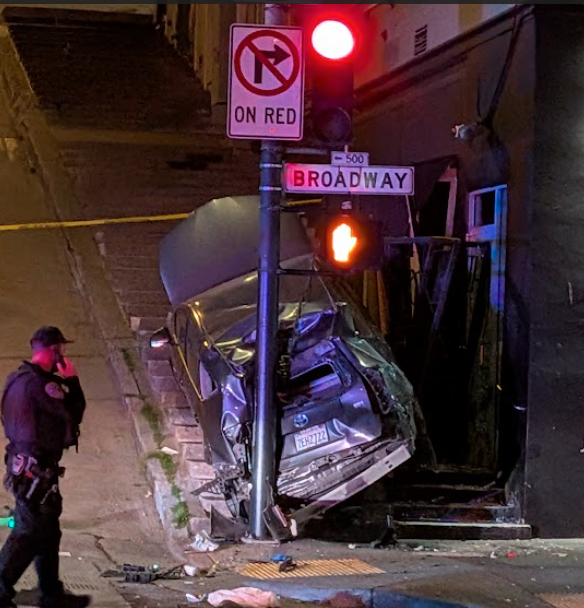
Motorist Careens onto North Beach Sidewalk, Killing Pedestrian
Driver kills pedestrian at another location where a safety project festered
The post Motorist Careens onto North Beach Sidewalk, Killing Pedestrian appeared first on Streetsblog San Francisco.







Comments Are Temporarily Disabled
Streetsblog is in the process of migrating our commenting system. During this transition, commenting is temporarily unavailable.
Once the migration is complete, you will be able to log back in and will have full access to your comment history. We appreciate your patience and look forward to having you back in the conversation soon.