

Making the Case for Compact Development

 From the people at Smart Growth America comes word of a new book, Growing Cooler: The Evidence on Urban Development and Climate Change, just out from the Urban Land Institute. In the book, researchers argue that more compact development (such as Atlantic Station, a mixed-use complex in Atlanta built on reclaimed industrial land, shown at right) must play a key role if this country is to reduce emissions:
They warn that if sprawling development continues to fuel growth in driving, the projected 59 percent increase in the total miles driven between 2005 and 2030 will overwhelm expected gains from vehicle efficiency and low-carbon fuels. Even with projected efficiency improvements, vehicle emissions of carbon dioxide would be 41 percent above today’s levels, rather than well below 1990 levels as required for climate stabilization by 2050, according to Growing Cooler….
The report cites real estate projections showing that two-thirds of development expected to be on the ground in 2050 is not yet built, meaning that the potential for change is profound. The authors calculate that shifting 60 percent of new growth to compact patterns would save 85 million metric tons of CO2 annually by 2030. The savings over that period equate to a 28 percent increase in federal vehicle efficiency standards by 2020 (to 32 mpg), comparable to proposals now being debated in Congress….
The findings show that people who move into compact, “green neighborhoods” are making as big a contribution to fighting global warming as those who buy the most efficient hybrid vehicles, but remain in car-dependent areas.
While demand for such smart-growth development is growing, government regulations, government spending, and transportation policies still favor sprawling, automobile-dependent development. The book recommends changes in all three areas to make green neighborhoods more available and more affordable.

Read More:

Support Streetsblog
More from Streetsblog USA
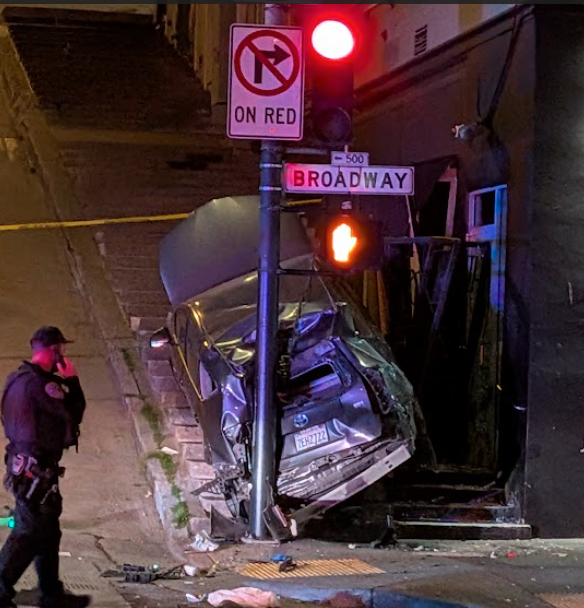
Motorist Careens onto North Beach Sidewalk, Killing Pedestrian
Driver kills pedestrian at another location where a safety project festered
The post Motorist Careens onto North Beach Sidewalk, Killing Pedestrian appeared first on Streetsblog San Francisco.







Comments Are Temporarily Disabled
Streetsblog is in the process of migrating our commenting system. During this transition, commenting is temporarily unavailable.
Once the migration is complete, you will be able to log back in and will have full access to your comment history. We appreciate your patience and look forward to having you back in the conversation soon.