

Studies & Reports
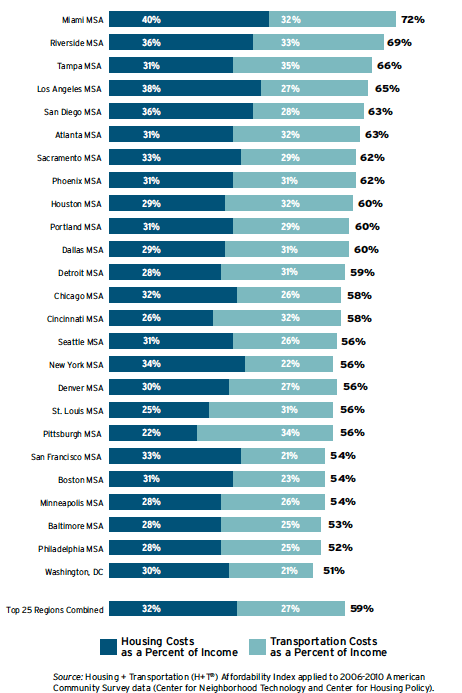
Why It Can Be More Affordable to Live in an “Expensive” City
So, how did Washington, D.C. -- widely perceived as one of the most expensive cities in the country -- end up topping a “most affordable” housing list?

October 19, 2012
How Much Bang Are Cities Getting From Federal BRT Bucks?
How substantial are the benefits delivered by federal investment in bus rapid transit projects, and how can the feds help local governments build better bus improvements? A new report from the non-partisan Government Accountability Office [PDF] looks at the results of BRT projects that have been completed in 20 cities since 2005, when SAFETEA-LU expanded federal funding eligibility for such projects. The GAO found that almost all of the projects have proven successful as cost-effective upgrades to increase ridership, but it also identified a few ways that federal policy provides incentives for local governments to avoid building bus projects that meet the standards for high-quality BRT.
July 31, 2012
Under Economic Impact Analysis, Highway Expansion Loses Appeal
Despite the common refrains about transportation spending creating jobs, most states don't actually give serious thought to the economic impact of transportation projects. More often than not, they're content to sink money into freeways despite a wealth of research that shows that transit, bikeways, and sidewalks deliver a much bigger economic bang for the taxpayer's buck.
June 12, 2012
One More Time: Here Are 4.6 Billion Reasons to Support Bike Infrastructure
Cyclists may only account for 1 percent of all trips taken in the U.S., but that's still good enough to save the American people a total of $4.6 billion per year, according to research recently released by the League of American Bicyclists, the Sierra Club, and the National Council of La Raza. The announcement coincided with National Bike to Work Day, observed last Friday as part of Bike Month.
May 23, 2012
Arizona DOT Study: Compact, Mixed-Use Development Leads to Less Traffic
Does walkable development really lead to worse traffic congestion? Opponents of urbanism often say so, citing impending traffic disaster to rally people against, say, a new mixed-use project proposed in their backyards. But new research provides some excellent evidence to counter those claims.

May 18, 2012
New Equity Atlas Tells a Story About the Future of Denver (With Maps!)
As more cities look to revive or expand their transit networks in the face of rising gas prices and maddening congestion, planners have had to remain vigilant to ensure that underprivileged communities are not displaced or adversely affected by the same transit improvements that could offer them numerous benefits.
May 7, 2012
Mileage-Based Fees or Bust: New Report Says “No More Excuses”
The shortcomings of the current gas tax are well-known. The federal rate (18.4 cents/gallon) has not been raised in nearly twenty years and is not tied to inflation, yet it remains the primary source of funds for federal transportation spending. The problem is exacerbated by improving vehicle fuel economy. And as electric cars roll off the assembly line in greater numbers and become the vehicle of choice for more drivers, relying on the gas tax as the primary source of transportation funding makes even less sense.
May 3, 2012
Let the Debate Begin: NYC, SF Snag Top Spots in First Transit Score Rankings
Today, Walk Score -- developer of the popular method for evaluating neighborhood walkability (and filling out NCAA tournament brackets) -- announced its first ranking of cities by Transit Score, a measure of the "usefulness" of a city's transit system. On a 100-point scale, New York and San Francisco took the top two spots with scores of 81 and 80 respectively, while Boston (74), Washington D.C. (69), and Philadelphia (68) round out the top five (see the full rankings).
April 26, 2012
Five Ex-Secretaries Map Out a Communications Strategy For Transportation
If 80 percent of the American people agree that federal infrastructure investment will create jobs, and two-thirds say better infrastructure is important, why is the call for a robust transportation bill being made in whispers? And why is Congress already two and a half years late in producing one?
April 24, 2012
How Local Transportation Decisions Can Put Public Health Front and Center
Transportation projects often have profound consequences for public health, whether negative (in the case of fossil fuel-burning highway expansions) or positive (in the case of calorie-burning bike-friendly, walkable streets). So why don't cities and states always consider health impacts when evaluating a transportation project or policy?
April 4, 2012